


The task of homework has been an integral part of the student experience for a long time. Many students find it beneficial to practice, while others view it as an unnecessary burden. Yet, a question will be asked over and over again:
Who was the person who invented homework?
Was it invented as a punishment? Did one teacher come up with it? Or is it a practice that has existed for a long time?
In this thorough and easy-to-understand guide, we’ll explore the true history behind homework, dispel some common misconceptions, and describe why homework became a fundamental element of the education system around the world.
The Popular Story: Roberto Nevilis
When people look online for the person who invented homework, they generally come across one name – Roberto Nevilis.
According to the most common tale:
- It was an Italian teacher.
- He proposed the idea of homework in 1905.
- He formulated homework as an alternative to punishments for his students.
This story seems convincing. But there’s a big issue.
There isn’t any evidence from the past of Roberto Nevili’s invented homework.
The education historians haven’t found any official evidence that proves the author of the story wrote his homework. The majority of experts believe that this story is an internet-based myth that was widely circulated without proof.
If Roberto Nevilis did not invent homework, who else did?
The answer is actually more complicated.
Homework Existed Long Before 1905
Homework wasn’t invented by chance during the early 20th century. In reality, various types of homework were in existence long before the invention of computers.
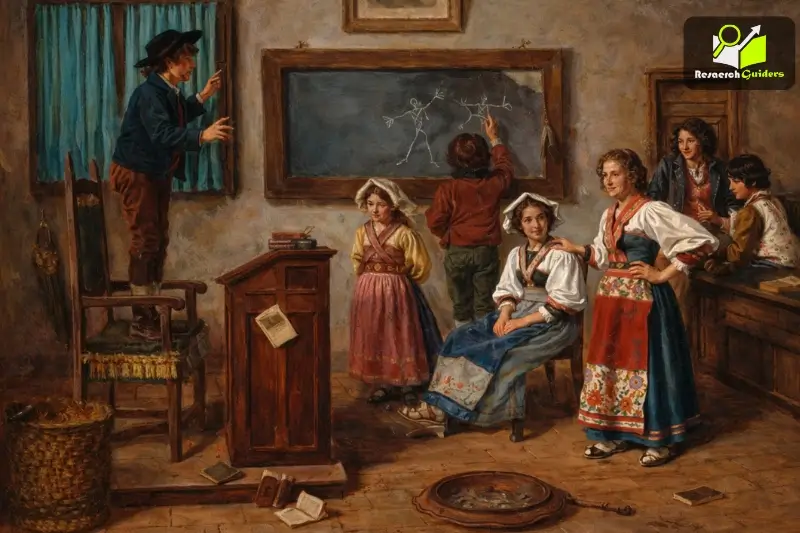
In the ancient world, students were required to study and practice outside of classes. Learning did not stop at the walls of the classroom.
Ancient Rome
Roman teachers encouraged students to practice their speeches at home. Students who were studying public speech were asked to practice and prepare for the class outside.
Ancient Greece
Greek philosophers advised students to think as they read, read, and practice the process at home. Learning was considered to be an ongoing process.
Ancient China
In traditional Chinese schooling, students learned texts and wrote characters during formal classes.
Homework-based learning was a reality before the advent of any contemporary schooling system.
This implies that homework wasn’t created by a single person. It was developed over time as educational systems developed.
The Role of 19th-Century Education Reform
While homework was a common practice in earlier times, it was more organized in the 19th century.
One important figure during this time was Horace Mann, an American educator who was a reformer. He was a scholar of European education systems, particularly in Germany, where students were already working on assignments in the absence of class.
In the years of expanded public schooling across Europe and the United States and Europe, homework became an integral component of the education curriculum.
At this time, homework was not considered a form of punishment. It was seen as:
- The reinforcement of classroom lessons
- Training for classes to come.
- A tool to develop discipline
This time period has helped to transform homework from a practice that was informal to an educational necessity.
Why Was Homework Created?
Instead of asking “who invented homework,” an alternative question could be:
Why was homework an integral part of the curriculum?
The introduction of homework was increased for various reasons.
First, the time in the classroom is not unlimited. Teachers can’t cover everything during the school day. Students can keep learning at home.
Second, practice improves understanding. Languages, mathematics, and science require repeated practice. Homework allows students to work on their skills in a group setting.
Thirdly, homework helps build accountability. Students are taught time management and self-control when they complete homework without supervision.
In the end, homework can help teachers determine the level of understanding students have. Assignments demonstrate whether students actually comprehend the subject matter.
As time passed, these benefits have made homework an integral part of all education systems around the world.
Read Also: Work Assignment Help – Smart Solutions for Academic Workload
Timeline of Homework Development
Below is a table that outlines how homework changed over time.
| Period | What Happened | Importance |
| Ancient Civilizations | Students worked on reading, writing, and delivering speeches at home | The early form of homework |
| Middle Ages | Religious schools require memorization in addition to class | Discipline is strengthened |
| 19th Century | Public education in the form of structured public schools has been expanded | The homework was formalized |
| Early 1900s | Homework is widely used throughout Europe as well as America | Integrated into schools |
| Late 20th Century | Discussions about homework are on the rise. | Concerns about stress and the effectiveness of |
| 21st Century | The digital age and the online platform for homework | Modern approach |
This table demonstrates that homework evolved over time and over the course of centuries. It was never invented by a single person.
Was Homework Ever Banned?
Interestingly, yes.
In the 20th century, certain educators believed that homework was detrimental, particularly for young children. They believed that
- It created stress
- It slowed down family time
- It restricted physical exercise
Certain regions temporarily limited homework for elementary school students.
As competition for academics increased across the world, homework was reinstated as a normal educational procedure.
The Homework Debate: Pros and Cons
Homework is still one of the topics that is most debated in the world of education today.
Benefits of Homework
The benefits of homework include:
- Reinforces the classroom learning
- Enhances memory retention
- Encourages independence in thinking
- Builds study discipline
- Preparing students for the exam
Students who practice regularly improve their academic abilities over time.
Disadvantages of Homework
But homework has some criticisms:
- Stress and anxiety can cause anxiety and stress.
- Reduces the time spent on free time
- Could cause a gap between students
- Burnout can occur if you are working too much.
Modern educators are focusing on “quality over quantity,” giving meaningful assignments instead of huge amounts.
How Homework Changed in the Digital Age
In the present, homework is quite different from what it was in the past.
Technology has changed the way assignments are distributed and completed. Today, students can:
- Online submission of work
- You can watch recorded lessons at home
- Complete interactive quizzes
- Participate in discussions via the internet.
The model is often referred to as a”flipped classroom”. “flipped classroom,” where students study at home, and then practice at school.
Homework is no longer restricted to textbooks and worksheets. It is now more customizable and flexible.
So, Who Was the Real Inventor of Homework?
We will now go back to the original issue.
Who invented homework?
The truth is:
The widely-held belief regarding Roberto Nevilis lacks historical proof. Homework changed over the course of centuries as the educational system developed.
Teachers of the past encouraged students to practice outside of the classroom. Reformers formalized assignments in the rise of schooling that was structured. As time passed, homework became standardized.
Instead of being created in a single year by a single teacher, homework is the outcome of centuries of progress in education.
Why the Myth of Roberto Nevilis Became Popular
You may be wondering what the reason is for Nevilis story being so popularly discussed.
There are several reasons for this:
First, people like simple answers. The idea of “one person invented homework” is much easier than explaining the ages of evolution.
Students who do not like homework may tell the tale with humor and claim it was designed as a punishment.
Third, the internet’s repetition makes myths appear to be factual. If a story is widely spread, the public begins to accept the claim as factual.
However, the research does not provide any solid evidence to support this claim.
Is Homework Still Necessary Today?
The field of education continues to develop. Some experts suggest that excessive homework can harm the health of students. Others think that homework is crucial for academic development.
New research suggests balance is crucial.
Effective homework should include:
- Be relevant
- Reinforce learning
- Age and the student’s ability of the student to match
- Beware of excessive work
Good assignments can be more beneficial than repetitive, long-lasting tasks.
If properly planned, homework can be an effective teaching tool.
Final Conclusion
The inquiry “Who was the inventor of homework?” doesn’t provide a clear answer.
Contrary to popular belief regarding Roberto Nevilis, no proof exists that one person invented homework in 1905.
The reality is that the evolution of homework happened slowly:
- The ancient civilizations of the past taught at home
- Reformers of the 19th century formalized the process
- Modern systems have grown and become digitalized. it
Homework wasn’t invented in a flash. It was developed when education systems expanded and changed.
The current homework environment continues to influence learning for students across the globe – sometimes controversial, and sometimes helpful; however, it is unquestionably influential.
Instead of asking about the inventor of homework, perhaps a better inquiry is:
How can homework be improved to help students in the most effective possible manner?
The conversation continues to this day.