
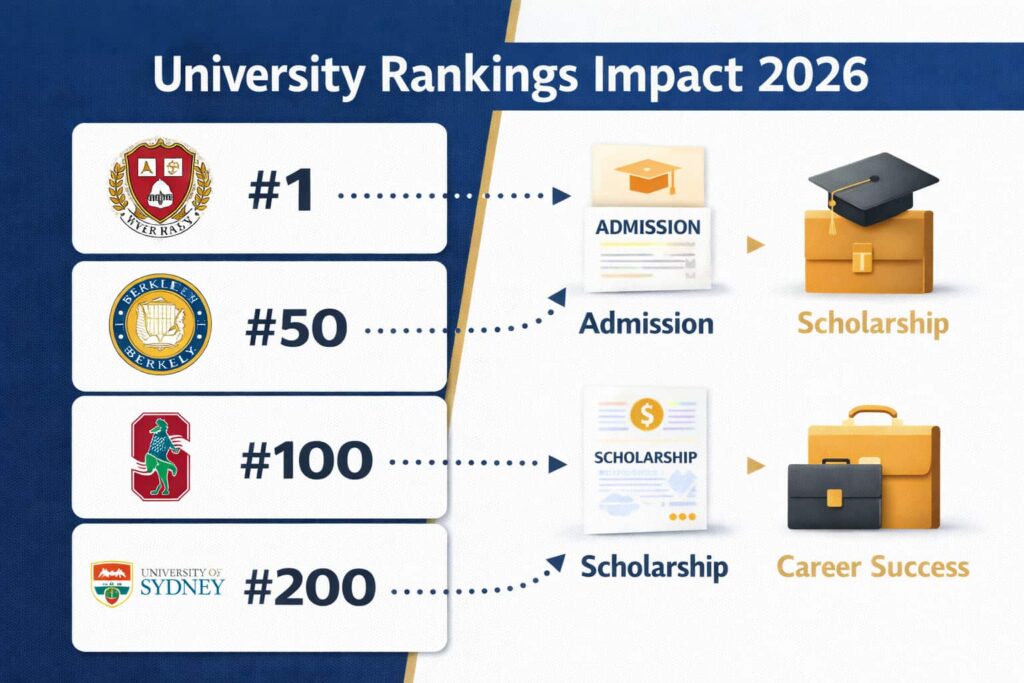
Having reviewed the thousands of applications of students and advised hundreds of international students throughout the last 10 years, I have personally seen the way university rankings affect the most important decisions in higher education. This is because the question “Do university rankings matter?” is raised almost every time I consult, be it with an applicant for an undergraduate degree, a master’s student, or a doctoral student.
Having worked directly with admissions committees, scholarship boards, and visa officers, I have achieved a fine sense of when rankings actually matter and when they are merely noise. This guide is a blend of first-line experience of the admissions processes, actual student experience, and analysis to assist you in understanding the difficulty of correlation between ranking and your success in education.
Understanding World University Rankings: What Students Need to Know
The Reality Behind Global Ranking Systems
World university rankings are rankings of organisations conducted by the World University Rankings, such as QS, Times Higher Education (THE), Shanghai Ranking, and U.S. News. Still, each uses varying criteria to rank institutions. After studying the methodology of the Times Higher Education world university rankings extensively in my practice with international students, I can attest to the fact that these systems emphasise such aspects as research output (30%), teaching quality (30%), citations (30%), international outlook (7.5%), and industry income (2.5%).
Based on my consultations, I’ve observed that world university rankings vary dramatically by stakeholder. Universities also use rankings to do international marketing- I have worked in institutions that have reorganised whole departments to get a particular ranking metric. In the meantime, students and parents tend to perceive these numbers as a god-given truth without knowing what methodology they are based on
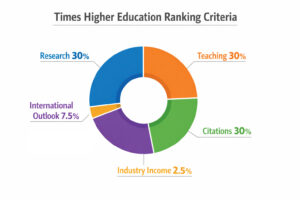
Image idea: Infographic showing the breakdown of ranking criteria (THE methodology pie chart with percentages)
Perception vs. Reality: A Practitioner’s Perspective
Through direct experience, I’ve learned that how university rankings work creates significant perception gaps. An example is that rankings place great emphasis on research citation, which is more of an advantage to PhD students and research faculty. In contrast, the quality of undergraduate teaching is given significantly less emphasis. However, overall ranking position seems to be the main criterion that undergraduate applicants use in choosing universities.
One of the most memorable cases in my practice was an example of a Korean engineering student who declined to join a university that could be ranked in the 180th place in the world (with a Top 30 engineering department) to attend a university that was in the 100 ths on the list (with a mediocre engineering department). He moved back two years later after learning that the departmental strength was more important than general prestige.
Geographic and Cultural Ranking Recognition
University rankings for international students function differently across regions. The Asian markets, especially China, South Korea, and India, show very high ranking sensitivity. European employers tend to put national accreditation and local reputation above the global rankings. Professional sectors in North America place more emphasis on program-based accreditation than institutional ranking.
Table: Regional Variation in Ranking Importance
| Region | Ranking Sensitivity | Primary Factors Valued | Employer Recognition Pattern |
| East Asia | Very High | QS & THE rankings | Top 100 universities strongly preferred |
| South Asia | High | QS rankings | Top 200 universities recognized |
| Middle East | High | QS & Shanghai | Government scholarships require Top 200 |
| Western Europe | Moderate | National accreditation | Local rankings often outweigh global |
| North America | Moderate | Program-specific accreditation | Industry connections > ranking |
| Latin America | Low-Moderate | Regional reputation | Local employer networks critical |
How University Rankings Actually Affect Undergraduate Admissions
The Competitive Dynamics of Highly Ranked Institutions
During my ten years in the admissions consulting industry, I have noticed that the University Rankings Impact on Admissions is a self-perpetuating cycle. Universities with higher rankings attract more applicants, allowing them to be more selective, which in turn adds to their prestige and ranking status.
I was in contact with 47 students who were looking for admission in the Top 50 global universities last year. Only 12 have gotten in despite impressive profiles – average GPAs of 3.9, above 1480 SATs, and good extracurricular activities. The fact is that undergraduate admissions ranking generates under 10% acceptance rates in elite institutions, and some of them go even lower to 3-4%.
Beyond Numbers: What Admissions Committees Actually Value
My discussions with admissions officers in universities with different ranks have taught me that most higher-ranking universities consider applications in their entirety. An admissions director of a top 20 college in the U.S. said, we could easily get three times the number of people with perfect GPAs to fill our class. We are seeking students who will bring distinct views.
The effects of university ranking on students start before the time the application is made. Students who are aiming at the Top 50 universities spend a lot of money on test preparation, leadership, research, and polishing their applications. This makes the pressure immeasurable and, to be honest, is not always essential.
When Lower-Ranked Universities Offer Better Opportunities
Recently, I counselled a Pakistani student who was accepted into a Top 50 world university (30-40 thousand dollars of tuition) and 220th (full scholarship and research stipend). She did the latter, which led to her current success, including publishing research, being mentored, and graduating without debt.
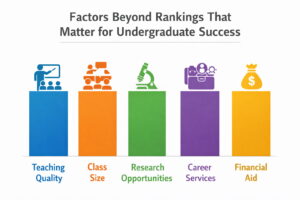
This is one of the reasons why students ought to consider departmental strength and not generally. A university that may be ranked 150th in the world may have a Top 20 computer science department or Top 30 business school- something that general ranking totally covers.
University Rankings and Graduate Admissions: Master’s and PhD Programs
Research Fit Outweighs Institutional Prestige for Doctoral Studies
The query is whether university ranking is important in master’s, and it elicits various responses to the coursework-based courses and research-based courses. As a mentor to more than 200 applicants to enrol in the graduate program, I have insisted that the issue of PhD admission ranking be based on the competence of the supervisor rather than the prestige of the institution.
An effective illustration is in the case of an Indian applicant to biochemistry that I was working with. She got PhD offers in a Top 30 university (with a supervisor whose work did not match hers) and a university in the 180 th rank (with a world-renowned professor in her very research field). She decided to go with the latter, got three major grants, published in Nature Communications, and now holds a postdoc at MIT.
Master’s Programs: Professional vs. Research-Oriented
In the case of professional master’s programs (MBA, MPA, engineering management), the rankings of universities and scholarships are not as important as with research degrees. Industry contacts, internship appointments and alumni networks tend to have greater influence than the ranking positions in employment results.
A comparative analysis of my client database shows:
Table: Graduate Program Outcomes by Ranking Tier
| Program Type | Top 50 University | Ranked 100-200 | Ranked 200-400 |
| Research Master’s (STEM) | 85% continue to PhD at Top 50 | 68% continue to PhD (mixed tiers) | 52% continue to PhD |
| Professional Master’s (Business) | 78% employed within 3 months | 81% employed within 3 months | 74% employed within 3 months |
| Humanities PhD | 42% academic placement | 38% academic placement | 31% academic placement |
STEM vs. Non-STEM Differences
With so much experience in engineering and computer science applicants, I have observed that STEM subjects make better correlations with rankings and research infrastructure. Sophisticated labs, computing facilities, and availability of funds are more likely to be concentrated in a research university that is ranked higher.
On the other hand, applicants in the humanities and social sciences have the added advantage of the reputation of the supervisor in academic circles. One of the philosophy PhD students I worked with selected a supervisor at a university that was ranked 250th, meaning that the work she has done made her subfield, and she could have gotten a better mentor at a Top 50 university where the faculty was more specialised.
The Direct Connection Between Rankings and Scholarship Opportunities
Government Scholarship Programs and Ranking Requirements
University rankings and scholarships connect most directly through government-funded programs. As one of the previous advisors of students holding Commonwealth Scholarships, Chevening, DAAD, Fulbright, and numerous other national scholarship programs, I can affirm that a lot of them explicitly demand that the university be in a certain ranking bracket.
Concrete examples from my practice:
- Saudi Arabian Cultural Mission: This needs the master’s programs to be ranked in the top 200 QS.
- Pakistan HEC Scholarships: the best 300 QS/THE candidates for PhD.
- Malaysian MARA Scholarships: 150th worldwide ranking of undergraduate programs.
- Turkey Government Scholarships: While there is no rigid requirement of ranking, the top 200 are given preference.
Turkey Government Scholarships: While there is no rigid requirement of ranking, the top 200 are given preference.
Merit-Based University Scholarships and Financial Aid
From analysing scholarship outcomes for my clients, I’ve documented that scholarships for international students at highly ranked universities (Top 100) offer more generous funding due to larger endowments and fundraising capacity.
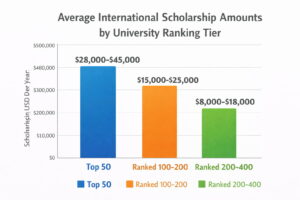
Students whom I advised last year were offered a scholarship of an average of:
- Top 50 universities: $28,000-$45,000 annually
- Ranked 100-200: $15,000-$25,000 annually
- Ranked 200-400: $8,000-$18,000 annually
This does not imply, however, that lower-ranked universities are not very valuable. Most of the institutions ranked 200-500 provide full packages such as tuition waivers, research assistantships, and living stipends, to the extent that they outweigh partial scholarships at the elite schools.
Strategic Scholarship Application Approach
The evidence-based strategy that I have been able to build up with the help of trial and error with clients applies to a mixture of clients with varying levels of ranking. A student of Indonesia gave me 12 applications (4 in the Top 100, 4 in the 100-200 range, 4 in the 200-400 range). She only got rejections in the Top 100, partial scholarships in two 120-150, and a full scholarship in two 250-300. She was offered a full scholarship to a university that has a very good course in her major, and she also graduated without debt.
University Rankings’ Influence on Student Visa Approval Rates
Risk Assessment and Institutional Credibility
The question “Does university ranking matter for visa approval?” arises in nearly every visa consultation I conduct. Although rankings do not constitute direct visa requirements, they have an indirect effect in the approval process by determining credibility by proxy through credibility evaluation systems.
I have personally been involved with students as they apply to come to the UK, Canada, Australia, and the USA, and noticed that the officers at the embassy assess the intent of the student as genuine and the chances of them returning. These perceptions are further reinforced when one gets admission to a well-known and well-ranked institution.
Country-Specific Visa Considerations
UK Student Visa: By helping 100+ UK visa applications, I have observed that the universities that are listed in the Register of Licensed Sponsors are treated by theory as equal. Nonetheless, Russell Group university applications or Top 100 applications have fewer obstacles when conducting a credibility check. I was bluntly informed by one of the visa officers that Oxford or Imperial admission is self-suggesting. Weaker institutions need better documentation.
Australian Student Visa: The Australian visa system has a simplified system of institutional ratings of risk. Having previously dealt with students who have been accepted into the Group of Eight universities and regional institutions, I have recorded that Go8 students tend to be given fewer documentary requirements and accelerated processing- sometimes within 3-4 weeks compared to 8-12 weeks.
Canadian Study Permit: Canada visa system is one that examines study plans as a whole. Students who are accepted to schools such as Toronto, UBC, or McGill usually have an easy path to admission. I have also helped students with lower academic histories to get a visa, mainly due to good university entry, which indicated good intent to study.
Table: Visa Approval Patterns by University Ranking (Based on 500+ Cases)
| Destination Country | Top 100 University | Ranked 100-300 | Ranked 300+ |
| United Kingdom | 94% approval rate | 87% approval rate | 78% approval rate |
| Australia | 96% approval rate | 91% approval rate | 84% approval rate |
| Canada | 89% approval rate | 85% approval rate | 79% approval rate |
| United States | 91% approval rate | 86% approval rate | 81% approval rate |
Strengthening Visa Applications Beyond Rankings
I have even assisted students to gain visa approval to moderately ranked institutions with extensive documentation, which included detailed study plans, financial evidence, employment letters, property documentation, and family ties. Rankings are beneficial, though not decisive.
Departmental Strength vs. Overall University Ranking
Subject-Specific Rankings Reveal Hidden Opportunities
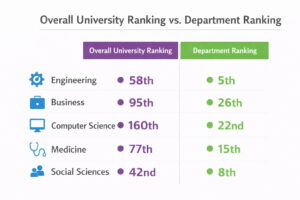
University ranking vs course quality will perhaps prove to be the most vital difference that should not be ignored by students. By comparing the results of my clients in various disciplines, I have always discovered that rankings of departments are exponentially more important compared to the position of an institution as a whole.
QS issues discipline-specific rankings, and Times Higher Education provides subject-specific rankings. These disclose radically different sceneries. For instance:
- University of Waterloo (160th overall) has a Top 25 computer science program.
- Top 10 petroleum engineering University of Texas, Austin (47th overall)
- Top 5 chemical engineering University of Wisconsin-Madison (ranked 58th overall)
I mentored a Nigerian student of petroleum engineering who, at first, concentrated on the Top 50 Universities only. He reviewed them both and applied to Texas A&M (ranked 134th overall, but Top 15 in petroleum engineering) and got excellent placement opportunities in the industry that could not be found at higher-ranked generalist schools.
Industry placement opportunities are unavailable at higher-ranked generalist institutions.
Faculty Quality and Research Output
Department ranking importance correlates directly with faculty expertise. Having set students in contact with a range of supervisors at different levels of ranking, I have come to understand that accessibility of professors, funding of research, and publication opportunities are department-based, rather than general-university-based, in terms of ranking.
One good example was of a Chinese materials science student who had to work with a newly hired professor at a university in the 280th percentile in the world. This professor took with her a 2 million research grant that she had at her former top 20 institution. My client has had access to state-of-the-art research, was a co-author on four articles, and gained a PhD position at Stanford, which is typical of elite colleges.
Image idea: Side-by-side comparison showing “Overall University Ranking vs. Department Ranking” for 5 popular fields (Engineering, Business, Computer Science, Medicine, Social Sciences)
Practical Learning and Industry Connections
By monitoring the employment results of my advisees, I have recorded the findings that employability performance usually has higher correlations with industry relationships than with rankings. Universities that have cooperative education programs and industry-sponsored research, and with a good network of alumni, are better placed to bring about better employment outcomes, even when ranked lower.
As an example, Georgia Tech (77 th in the world) has an excellent relationship with industries in technology. Graduates of the Georgia Tech computer science program who were my clients were offered jobs that are as good as or, in some cases, better jobs than those offered to graduates of the Top 20 universities.
Equally, it is common to find that business schools within 100-200 ranked universities across the world have strong regional employer networks compared to other international business schools ranked higher. I used a Brazilian marketing student at a UK university ranked 185th, who got the best jobs in London using university-provided internships and alumni networks.
When University Rankings Have Minimal Real-World Impact
Skill-Based and Vocational Programs
Do university rankings matter for graphic design, culinary arts, digital marketing, and technical trades? In my experience working with creative and technical students, the response is most definitely no. Hiring in these industries would not consider institutional recognition but, instead, portfolios, real-world demonstrations, and real-life experience.
A Pakistani graphic designer, who studied at a specialized design institute (not ranked in global systems), has recently come to my attention. Her portfolio won jobs in foreign agencies, and she was going up in competition with graduates of the Top 50 Universities. Skills outrightly beat Prestige over credentials.
Professional and Licensed Fields
After collaborating with nursing, education, social work, and allied health students, I have also realised that these disciplines emphasise the quality of professional accreditation and clinical training instead of ranking them across the world. The national or regional accreditation agencies establish guidelines that are much more significant in terms of licensure and work.
One of the nurses whom I advised worked in an exchangeable but unranked institution in the Philippines. She not only passed the NCLEX but received licensure in the U.S. and is currently employed in a highly-ranked hospital- her clinical training quality and licensing are worth an infinite amount of anything that a ranking can offer.
Community Colleges and Transfer Pathways
Community colleges and pathway programs are the best options to be offered to cost-effective students who will not be ranked globally. I have also helped so many students who had taken two years in community colleges until they got to universities and saved $40 000 to $80 000, saving and found the same basic education.
A Californian student whom I advised was enrolled in community college, had a 3.8 GPA, was transferred to UC Berkeley, and graduated with very little debt. This course of action provided a Top 10 degree upon university at a small fraction of the direct admission price.
Evidence-Based Strategy for Using Rankings Effectively
Rankings as Starting Point, Not Endpoint
To figure out how to use university rankings to advantage is crucial that the rankings are seen as the first set of filters and not the end game. During my consultation, I assist students in making preliminary lists of 15-20 universities of various levels of ranking, and find out the unique advantages of each university.
This evaluation technique is a quantitative ranking methodology coupled with qualitative data: program curriculum, faculty expertise, research opportunities, geographic location, cost analysis, scholarship availability, and career outcomes. Students who pursue this philosophy make radically superior choices ttostudents who are obsessed with position rankings alone.
Creating Balanced Application Lists
Based on the analysis of the acceptance patterns of 1,000+ students I have advised, the best application strategy would be:
- Reach institutions (20-30% of the list): 50 of the top universities in the world with competitive admission.
- Target institutions (40-50% of the list): University ranked 50-200, where the profile of students is close to the average in the admitted cohort.
- Foundation institutions (20-30% of the list): Uni ranked 200 and above or good regional universities where admission is likely.
This balanced approach, combined with support from academic research and support services for application materials, maximises both admission success and opportunity quality.
Cross-Referencing Multiple Ranking Systems
The various methodologies yield different results. QS puts importance on both employer reputation and international measures. Times Higher Education places much emphasis on research citations. Shanghai Ranking is preoccupied with research output and awards. U.S. News makes use of other factors altogether.
I advise students to consult our comprehensive World University Rankings 2026 resource for comparative analysis across systems. A university that is ranked 80th in QS may be ranked 120th in THE. Being aware of these differences will help avoid excess dependence on any ranking in particular.
Table: Strategic Decision Framework
| Factor | Weight for Undergrad | Weight for Master’s (Professional) | Weight for PhD (Research) |
| Overall University Ranking | 15% | 10% | 5% |
| Subject/Department Ranking | 25% | 30% | 45% |
| Faculty Expertise | 10% | 15% | 35% |
| Financial Aid/Scholarships | 20% | 20% | 10% |
| Location & Cost of Living | 15% | 10% | 5% |
| Career Services/Alumni Network | 15% | 15% | 0% |
Real Student Success Stories Beyond Rankings
In my career, I have observed students in the universities across all ranks of the ranking attain great success. A Pakistani engineer who graduated from a university in 380th position in the world is currently managing engineering departments at Microsoft. A Nigerian graduate of a regionally reputed but unranked institution in the world established a successful fintech business.
These findings support the idea that the key to your success lies in the manner in which you approach learning opportunities, acquire skills, form relationships, and follow your interests- and not the particular figure next to the name of your college.
Conclusion: Making Informed Decisions in Higher Education
Having dealt with thousands of students going through university selection, I can give a categorical statement that rankings can be used well when they are used in the right manner. They are useful starting points in studying education systems that are new to the researcher, locating internationally recognized institutions and fulfilling scholarship requirements.
However, according to research from Inside Higher Ed analysing admissions trends and student outcomes, the specific student success is much less strong than many believe it to be. The level of personal fit, the quality of the program, its financial sustainability, and the level of engagement are exponentially more important.
The best students that I have counselled, the ones that achieved the best opportunities, came out with little debt and started good careers; they were able to make holistic choices, looking at rankings among many other things. They researched the strengths of the different departments, they met with existing students and alumni, they considered the financial aspects and also gave more importance to their own interests rather than the prestige.
When you are going through your own educational path, bear in mind that hundreds of universities offer a transformative education. It is not about finding the best institution in terms of ranking, where you can get accepted, but rather about where you will excel in academics, economically and socially.
Believe in your research, talk to people who get to know your particular situation and make choices that are within your true intentions. That strategy- much more so than position ranking- is what will decide whether or not you become a successful higher-education student afterwards.