


It is important to learn how to compose a DBQ Essay if you’re preparing for AP History Exams such as AP U.S. History or AP World History. Students are challenged to use historical documents to support their argument in a Document-Based Question essay. It may be intimidating, but following a structured strategy and structure can help you to master this essential academic skill.
What Is a DBQ Essay?
DBQ essays are a special type of essay found on AP History tests. Unlike other essays that rely on research or knowledge, a DBQ asks you to examine historical documents to build an argument based on evidence.
Documents can include letters, cartoons, maps, and graphs. An exam typically provides between and -16 documents that each offer a unique perspective on a historical event or topic.
A DBQ essay will test your analytical abilities, understanding of history, and ability connect evidence with a strong argument.
The following are the key elements to a DBQ Essay:
- The thesis should be clear and concise.
- Multiple documents can provide evidence
- Contextualization without historical knowledge
- Analysis of all the points.
Example DBQ Prompt
The Cold War had a profound impact on a country’s politics and society between 1945 and 1989.
This prompt requires you to provide context and analyze Cold War documents. You will also need to construct an argument that addresses the political and social impact.
Why DBQ Essays Are Important
DBQ Essays are important for many reasons.
- Students are required to evaluate and interpret primary sources, which develops critical thinking.
- Instead of relying on memorization, they encourage arguments based on evidence.
- Students learn to recognize patterns, cause-and-effect, and different perspectives.
- Students are prepared for writing assignments and research at the college level.
The first step in writing a high-scoring DBQ response is to understand the essay’s meaning.
Step-by-Step Guide to Writing a DBQ Essay
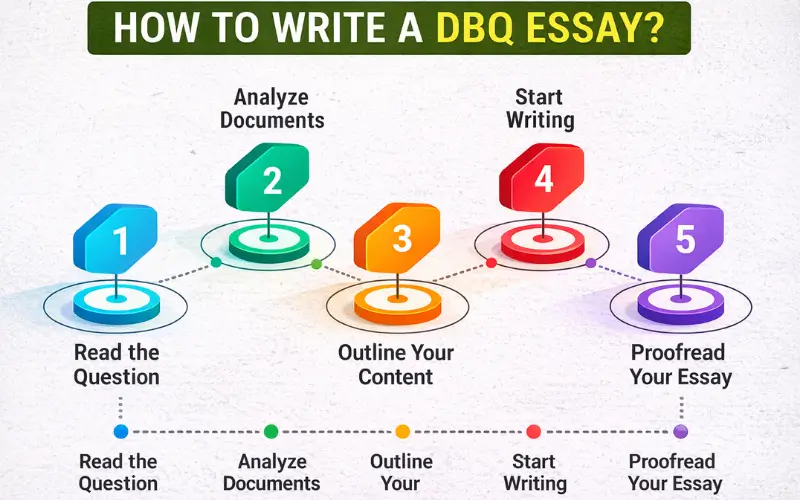
Due to the time restrictions and multiple documents, writing a DBQ can be overwhelming. This is a structured way to approach it with confidence:
Step 1: Read the Prompt Carefully
Understanding the question completely is essential to writing a DBQ. Read the prompt carefully and underline words like compare, explain, analyze, or evaluate. To ensure that you answer the question fully, identify the period of time, geographic focus, and scope.
Ask yourself key questions:
- What’s the question?
- Is the prompt divided into multiple sections?
- What type of essay is expected–cause/effect, comparison, or change over time?
This step should take you 5-10 minutes. It is a common mistake to misunderstand the question. This can have a negative impact on your argument. You can build a solid foundation by fully understanding the prompt.
Step 2: Analyze the Documents
For a good DBQ, it is important to analyze each document carefully. Each document has evidence, a perspective,e and potential bias. Understanding these elements is essential to effectively support your thesis.
Consider the following when analyzing documents:
- What type of document is it? Is this a law, a chart, a photograph, an e-mail, or a fax?
- What is the author’s perspective? Take into account their occupation, position in society, and political views.
- What is the historical context? When and where did it occur? What is the influence of the historical period on the content?
- What is the purpose of your document? Was it to educate, convince, justify, or criticize you?
- Perspectives and biases: Do you have any underlying prejudices or assumptions?
- Relevance: What is the relationship between the document and the question?
A grouping of documents by perspective or theme can make organization easier. A DBQ about the Progressive Era, for example, could be broken down into three sections: social reform, economic reform, and political reform.
Time recommended: 15 minutes
Step 3: Develop a Strong Thesis Statement
It is the core of your DBQ paper. The thesis statement should answer the question directly, summarize your arguments, and cover all aspects of the question. Your thesis statement should also reflect any themes or groups identified within your document.
Strong thesis statements are concise, precise, and defended. The thesis acts as the roadmap of your essay. It guides both you and your readers. Your essay will be unfocused and disorganized if you don’t have a thesis.
Example:
The Progressive Era was a time of significant reforms in economics, political accountability, and social justice. However, the impact on different segments of American society is uneven.
Examples of thesis
The industrialization of 19th-century Europe boosted economic growth but also created class divisions and harsh working conditions in cities, which are reflected by contemporary accounts.
Avoid vague statements such as “The Civil Rights Movement has changed America.”
Step 4: Create a Brief Outline
A good outline can serve as your guide for writing an essay. Divide your essay into:
- Thesis + context
- Body Paragraphs 2 – 3: Themes + Documents + Outside Evidence
- The conclusion should include a summary of the thesis and broader implications.
Plan your outline in 5 minutes. Clear planning saves time during writing.
Outline example for a Progressive Era DBQ:
| Paragraph | Focus | Documents & Evidence | Outside Knowledge |
| Intro | Context + thesis | N/A | Social changes in late 19th-century US |
| Body 1 | Women’s suffrage | Doc A, B | 19th Amendment, activism |
| Body 2 | Political reform | Doc C, D | Muckraking journalism, direct democracy |
| Body 3 | Economic reform | Doc E, F | Labor laws, antitrust acts |
| Conclusion | Broader significance | N/A | Long-term social and economic impact |
Start writing as soon as you have a plan. Clarity, structure, and evidence are important.
Step 5: Write the Essay
Write the introduction
- Historical context
- Introduction to the topic
- Your thesis statement
Example:
The Progressive Era (1890-1920), in the United States, was marked by rapid urbanization and industrialization. This created social challenges that demanded reform. It is clear from the analysis of different documents that economic, social, and political changes have reshaped American culture, giving citizens more power and helping to address systemic inequality.
Writing Body Paragraphs
Include: Each paragraph should be focused on one idea. Include:
- Thesis sentence linked to the topic
- At least two documents are required to prove the existence of a document.
- Analyse the document’s content, perspective, and purpose.e
- Contextual knowledge of outside information
- Translation
Example Body Paragraph:
Topic: Women’s Suffrage and Social Reform
Document A is a letter from a suffragette, which highlights the increasing demand for political equal rights. Document B illustrates the societal opposition to women voting. The 19th Amendment, which was passed in 1920, granted the vote to women, reflecting the social reforms that characterized the Progressive Era. These sources together show how grassroots activism helped shape national policy and promoted social justice.”
Writing the Conclusion
- The thesis should be rephrased in new words
- Summary of main points
- Historical significance of a broader scope
Example Conclusion:
The Progressive Era transformed American society fundamentally by improving women’s equality, political accountability, and economic justice. Documents analyzed provide insightinton both reform successes and failures, as well as their long-lasting impact. The movement showed the collective power to influence national policies and social values.
Must Read: 15 Easy Thematic Statement Examples to Improve Your Writing
Step 6: Include Outside Knowledge
In order to get top marks in your documents, you should include relevant historical data that has not been explicitly stated. Knowledge from outside the document shows a deeper understanding of your subject and increases credibility.
Include important dates, significant leaders, major court decisions, and treaties or other events that are relevant to your topic. These additional details will help you to support your claim more convincingly.
You might, for example, write the following in a DBQ on the Progressive Era:
The Sherman Antitrust Act of1890 and the Clayton Antitrust Act of14, which go beyond the documents themselves, are examples of the Federal Government’s involvement in the economic reform of the Progressive Era.
The sentence connects document analysis with broader historical events. It is better to use outside knowledge in order to enhance the analysis than it is for you not have any.
Step 7: Review and Edit
Always reserve 3 to 5 minutes for reviewing your essay, even if you are on a tight schedule. The editing process improves the clarity of your essay, its accuracy, and effectiveness.
Make sure that the thesis statement is clear and supported consistently throughout your essay. Check that the paragraphs flow logically, and that all ideas are connected smoothly. Verify that your citations are correct and you’ve balanced the evidence with an explanation.
Check for errors in grammar, spelling,g and sentences. Even minor corrections will improve the readability. You can identify any awkward phrases or unfinished thoughts by mentally reading out loud your essay.
An excellent essay can be transformed by a brief summary at the end.
Common Mistakes to Avoid
| Mistake | How to Avoid |
| Weak or missing thesis | Write a clear, specific, and defensible thesis |
| Summarizing documents only | Analyze how documents support your argument |
| Ignoring outside knowledge | Include 1–2 relevant facts per paragraph |
| Poor time management | Follow the recommended time breakdown |
| Skipping conclusion | Restate thesis and summarize evidence |
DBQ Essay Example
What was the impact of the Progressive Movement on social, economic, political, and cultural life between 1890 and 1920?
Thesis + context
Documents A and B: Body 1. Women’s rights, social reforms
Documents C and D: Body 2. Political Reform, Muckraking Journalism
Documents E and F: Body 3: Economic Reform, Labor Rights, Antitrust Laws
The impact of history on a broader scale
This example shows you how to combine documents, external knowledge,e and analysis in a strong DBQ.
DBQ Essay Tips to Improve Scores
- Practise regularly using past DBQ questions
- Grouping documents according to theme will make writing easier.
- Analysis is the key, not description.
- Each paragraph should have a clear topic sentence.
- Integrate outside knowledge seamlessly
- Manage your time effectively (prompts 5-10 minutes, documents 10-15 min, writing 30-40 min, reviews 3-5 min).
- Model DBQ Essays to Understand Style and Flow
Suggested DBQ Writing Timeline (60 minutes)
| Task | Time | Description |
| Read prompt & documents | 10–12 min | Understand the question, annotate sources |
| Create thesis & outline | 5–7 min | Draft thesis, group documents by theme |
| Write essay | 35–40 min | Introduction, body paragraphs, conclusion |
| Review & edit | 3–5 min | Check grammar, clarity, and evidence use |
Conclusion
It may be intimidating to write a DBQ, but if you approach it in small steps,s the task becomes much easier. To ensure that your essay covers all aspects of the question, start by understanding the prompt. Analyze the documents, noting their viewpoints, biases, and relevance for your argument. After you’ve analyzed the evidence thoroughly, create a thesis statement that is specific and strong. This will help guide your essay. Create a structure outline to help organize your thoughts. This will allow you to write body paragraphs that are supported by document evidence and external knowledge. Focus on providing clear, concise explanations and connecting your thesis to the analysis. Also, integrate historical context. Set aside some time at the end to edit and review your essay, and check for accuracy, clarity, and logical flow. Students can learn the DBQ format with a consistent strategy and practice. They will impress their examiners and get top marks.
You Also Like:
Academic writing services