

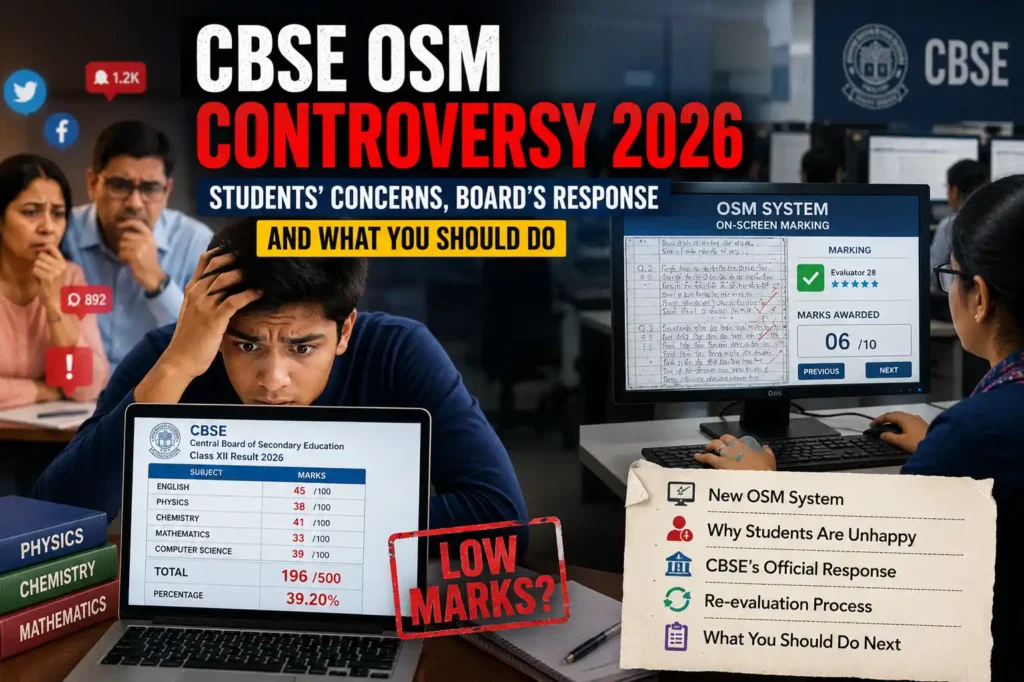
The CBSE Class 12 Result 2026 was announced on May 13, not just with the results, but also with a big controversy. Students and parents in India and the UAE, in thousands across the nation, were shocked and disappointed when they were given low grades. The assessment mode that the CBSE (Central Board of Secondary Education) introduced in 2026, called CBSE On-Screen Marking (OSM), received a lot of criticism.
Immediately after the reaction, the Central Board of Secondary Education (CBSE) released an official statement, which read that it was “extremely sensitive” to the students’ concerns. The new digital evaluation method was adopted to make it easier, more transparent and accurate to check the CBSE board exams, the CBSE says. But many students and parents still wonder if final results were impacted by the new assessment program.
This issue is now one of the biggest in education for 2026. Board exam percentages directly relate to getting into top universities, engineering colleges, and professional courses, causing students to be particularly concerned.
What Is the On-Screen Marking (OSM) System?
The On-Screen Marking (OSM) is a change in CBSE from a paper-based marking method to a full paperless system of marking. In this format, answers are turned in to the scanner and submitted online to a secure website where exam papers are marked electronically on a computer screen.
How the OSM System Works
At the board exams, the actual answer sheets are first converted into digital copies. The scanned copies are then uploaded to the secure evaluation portal maintained by CBSE. Answers are manually checked by trained teachers/evaluators using their computer screens, rather than looking at a physical answer booklet.
The marks entered are digitised during the assessment process, which decreases manual calculation error and clerical error that may be a problem with conventional checking processes.
Why CBSE Introduced the OSM System
CBSE has implemented the digital evaluation system for enhancing uniformity and efficiency in the country. The board says the system has been developed in an effort to improve transparency and consistency in marking.
The board’s goals for the new system were to accomplish several significant things:
- Standardization of assessments.
- Inspection of the management of compliance with improved transparency.
- Improved markability of messages.Improved accuracy in marking messages.
CBSE also desired quicker processing of results and minimized manual errors in total marking.
CBSE Clarified Human Evaluators Were Used
rumours on social media spread, after which CBSE clarified that the answer sheets were not analysed by artificial intelligence or automated software. The board said that all papers were evaluated by trained teachers, but the computer screen was the instrument by which papers were evaluated.
Also, the board stated that before the digital marking system was implemented throughout the country, multiple training sessions and dry runs were carried out.
What Went Wrong? Students’ Concerns Explained
The outcry against the results – despite the preparatory work by CBSE – was very strong. Pupils from various areas reported not having achieved what they had anticipated.
Unexpectedly Low Marks in Major Subjects
There were a large number of students who said they had significantly lower marks than they expected, particularly in Physics, Chemistry, Mathematics, and Biology. A number of students who were earning regular high grades in school and had done well in their pre-board exams were surprised when they came out with a different set of board percentages.
Parents also asked, “How is it that after having good records, students suddenly had such sharp drops in scores?”
The JEE and Board Exam Score Contradiction
One of the most important was the JEE Main qualified students who did not manage to score 75% marks in their CBSE board exams to be able to take admission in an IIT or NIT.
This generated a mix-up since JEE Main is one of India’s challenging engineering entrance exams. Many of the students complained that it would appear difficult to secure a competitive exam after a poor performance in board exams.
The whole situation soon turned into one of the strongest oppositions to the new CBSE On-Screen Marking (OSM) system.
Concerns About Scanning Quality
Some students reported that diagrams, their rough working out, or answers written near the margins of the page may not be easily seen after scanning. In these complaints, the evaluators are accused of missing parts of the answers due to unclear scans.
Additionally, teachers and experts in education examined the possibility of affectation of the facet when evaluating digitally by using a scanning device.
Difference Between Pre-Board and Board Scores
Several parents indicated that students with very high scores in the school board exams were given very poor scores in the official board exams.
The significant gap between school and final assessment results led to concerns regarding the consistency of the assessments.
Social Media Backlash Against CBSE
Students’ platforms were soon overwhelmed by people posting complaints and screenshots of their results, starting with Twitter/X, Instagram and other social media platforms like Reddit.
There was a sudden drop in marks and passing percentage in the CBSE exam, which is why hashtags for the CBSE On Screen Marking (OSM) became trending.
CBSE’s Official Response to the Controversy
There has been a debate on the evaluation process, which has been responded to by CBSE with an official statement between 15th May and 16th May 2026.
CBSE Said It Is “Extremely Sensitive.”
None of the board’s business is conducted without its prime concern being the welfare of every pupil, it has been told, and it has no doubt whatsoever of the concerns expressed by students and parents.
CBSE guaranteed all students that any complaints would be handled in the proper channels.
Human Examiners Conducted the Evaluation
CBSE vehemently refuted allegations of the use of AI for checking answer sheets.CBSE vehemently rejected the allegation of the use of artificial intelligence to check answer sheets. All assessments were made by certified teachers on trained screens, according to the board.
The board stressed that the technology was used to facilitate checking.
Board Defended the OSM System
According to CBSE, the electronic assessment system is more fair and helps reduce common marking mistakes like incorrect totaling or omitted answers.
The board also stated that the system makes it easier to have uniform marking procedures in different exam centres and regions.
Students Asked to Use Official Channels
Students and parents have been discouraged from following rumors about the exam on social media by CBSE. The board, rather, invited all of them to address their concerns at the official portals and helplines relating to results.
Re-Evaluation Process Officially Opened
The board agreed that students are entitled to apply for verification/re-evaluation if they feel that their marks were inadequately or unfairly awarded.
The Numbers That Increased the Controversy
Things got even harsher after the official pass percentage was published.
CBSE Class 12 Pass Percentage Comparison
| Year | CBSE Class 12 Pass Percentage |
| 2025 | 88.39% |
| 2026 | 85.20% |
The pass rate of 2026 (85.20%) was the lowest in the previous seven years. The immediate plunge of over 3 percentage points raised immediate questions, as this coincided with the launch of the new digital evaluation process.
The tougher criteria around digital checking were thought to be a factor in the drop in results for many students and education professionals.
Re-Evaluation Process Explained for Students
The CBSE officially declared that the re-evaluation procedure would start from 19th May 2026. If students are not happy with their results, they should use the official marking procedure.
Step 1: Apply for a photocopy of the answer sheet
Students have to first register on the official CBSE portal to get the scanned copy of the evaluated answer sheet.
This gives the student time to examine the marks given and, if necessary, areas that were not marked.
There is a fee associated with a photocopy request, which must be paid when submitting the request.
Step 1: Apply for a photocopy of the answer sheet
Students can either check or re-evaluate their work by looking at the answer sheet.
Marks can be verified, so students can see if the total marks were added correctly and if all the answers were checked correctly.
Specific answers can be again considered by another examiner (re-evaluation).
Important Things Students Must Remember
- The application deadline is before the official deadlines.
- There are required charges for verification and re-evaluation requests.
- Final marks may be subject to re-checking, which may lead to an increase or decrease in final marks.
If the discrepancies are found during the CBSE review process, the corrective action will be initiated.
A student can, according to the CBSE norms, be allowed to appear in the Compartment exam in any failed subject.
Expert Opinions on the OSM System
The controversy has raised wider debate in the educational circles and among teachers across the country in India.
Some Experts Believe the Transition Was Too Fast
Some teachers modified their stance to say that going all-in for national digital assessment in the first year could have been too much.
They say that more training and adaptation time are needed for examiners to feel comfortable with screening through a screen.
Concerns About Scanning Clarity
Education experts stressed answer sheet scanning quality concerns as well. In cases of blurry or faint handprints or diagrams, it can be difficult to make out what is meant on the computer screen.
This aspect emerged as one of the most talked-about technical queries relating to the CBSE On Screen Marking (OSM) system.
Others Defended the New Evaluation Method
Other educators embraced the digital evaluation system, citing instances of marking out by clerical error, missing answers, and errors in marking the calculation of marks on paper.
Supporters of the system say the digital marking is more consistent and less prone to manual errors.
CBSE’s Position: The OSM System Will Continue
So, there is no indication from CBSE that it is going to withdraw this new assessment technique till May 2026.
Rather, the board has been standing up for the CBSE On-Screen Marking (OSM) to highlight its significance as a modernization measure for the Indian educational system.
The general criticism, however, has put the possible pressure on CBSE in improving some parameters in it.
Areas Where Improvements May Be Needed
CBSE should enhance the quality of scanning to ensure clarity of answers and diagrams in evaluations.
There may also be a need to train examiners further and to give more detailed instructions for examiners on how to assess diagrams, margin writing and presentation-based answers.
Many of the experts also proposed the formation of a more robust and effective grievance resolution mechanism to address students’ grievances effectively.
What Students and Parents Should Do Right Now
Pupils involved in the scandal should not panic but need to follow procedures.
Important Steps Students Should Follow
- Healthily deal with emotions; do not fall for misinformation via social media.
- Submit requests for answer sheet photocopies ASAP
- Pay attention to answers before asking another to re-evaluate
Students also need to follow the official CBSE website for updates and deadlines and instructions regarding the correction process.
Why Official Channels Matter
There can be miscommunication and undue worry caused by unofficial social media claims. Students must only trust information from trusted CBSE announcements, helplines and notifications.
Students should also be emotionally supported by parents during this stressful time, as the results of the board exams may generate a lot of pressure in academics.
Conclusion
The CBSE On-Screen Marking (OSM) System controversy of 2026 has shed light on the difficulties of implementing education reforms on a large scale. The system would provide increased transparency, speed and accuracy, but its inaugural rollout has spooked thousands of students and their parents.
This is very significant as CBSE says that it is taking student concerns into account, and it has made the digital evaluation process to ensure fair and accurate board exam scores. But many families are yet to find out if there are any meaningful corrections in the re-evaluation process where needed.
Currently, the board has only stated that it will not end the digital evaluation system for this school year. If students think they have been awarded an unfair mark, they should be careful to use the official re-evaluation procedure and not accept rumours or unofficial claims.
Read Also: Guide to Work From Home Australia for University Students