

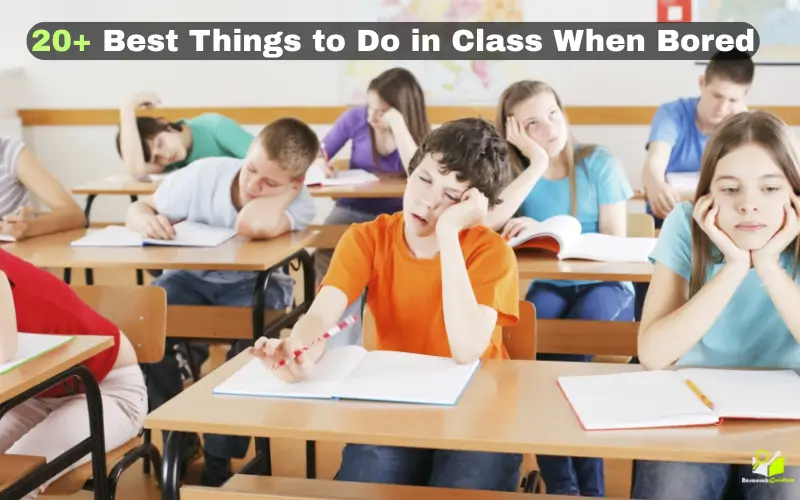
It is not an exception that every student has a feeling of being bored in the classroom. Anybody in high school, college, or online lectures in the USA has found themselves having their thoughts wander and mind lost. The positive aspect is that boredom need not be understood as time wastage. You will be able to be productive, entertained, and even enhance your learning with the right strategies. Below are 20 entertaining, silent, and low-profile activities to consider when bored in class.
Brain Boosters for Mental Energy
1. Mindful Breathing Exercises
One of the easiest methods of calming your mind is mindful breathing. When you are bored or distracted in the classroom, your concentration is poor. Meditative breathing can refresh your mind. Sit up and inhale slowly in four seconds. Breathe in and hold your breath for four seconds. Then exhale gradually every four seconds. Repeat this 4 to 5 times. This is a form of stress relief that enhances attention and mental acuity. It can also be used to manage anxiety during protracted lectures.
2. Doodling or Sketching
Doodling is a creative, secretive practice. To keep your brain on the move as you listen, you can draw small shapes, flowers, patterns,s or simple cartoons. Research indicates that sketching light exercises helps in improving memory and attention. When you move your hands, your brain remains active. You do not need to be an artist. Straight lines and designs suffice. All you have to do is to remain respectful and never disregard valuable guidelines.
3. Mental Math Challenges
The brain exercise called mental math is good. You are not bored because you can do simple mathematics in your head. Attempt multiplication of two numbers, calculation of percentages, and summation of numbers. e.g., multiply 80 by 15 per cent or multiply 23 by 7 in the mind. It enhances problem-solving ability, logical thinking, and brain quickness. Mental challenges will frequently make your mind sharp and active.
4. Memory Games
The practice of memory enhances your learning power. Silently check yourself by remembering what you learnt yesterday or last week. Attempt to recall significant historical dates, scientific equations, or new words. Youcan evenn repeat some important points of the lesson currently taking place in your head. This enhances memory and long-term memory. Good memory abilities enable you to do well in tests.
5. Silent Crossword Puzzles or Word Games
Word games are enjoyable and also educational. It may be a small crossword or word search puzzle that you keep in your notebook and can be used during idle times. The activities enhance vocabulary, spelling,g and critical thinking. They also educate your brain to identify patterns and relationships of words. Ensure that you address that at the most appropriate time, and in a dignified way.
Must visit: Victorian School Holidays 2026
Educational Fun to Pass the Time
6. Creative Note-Taking
Inspired note-taking would render learning interesting. Write not simple sentences but headings, bullets, arrows, boxes, or mini drawings. You are capable of making diagrams, flowcharts, or mind maps to relate the ideas. Important color keywords. This enhances learning and recall. Your notes appear readable and tidy; you study more easily before exams. Innovative notes make your brain busy, too, during the long lessons.
7. Summarize Lessons in Your Words
A summary after each topic will contribute to a better understanding. Use simple language and present the idea like you are teaching a friend. Make it not too long, 4 or 5 sentences. This process enhances learning since your brain digests data massively. You retain ideas better when you paraphrase them. It enhances writing and communication skills as well.
8. Predict the Next Lesson Topic
This is because prediction creates interest and attention. Consider what the teacher is going to tell you. Check the chapter title, headings, or lessons before it. This causes your mind to be prolific rather than idle. The ability to make predictions enhances critical thinking ability and makes you more attentive to listening to whether your prediction is right or not. It makes learning a small challenge to the mind.
9. Flashcard Practice
Flashcards are efficient reviewing devices. Draw a question on one hand and the answer on the other. You are able to revise definitions, formulas, vocabulary, or main facts. Electronic flashcards are also acceptable in a classroom. Flashcards are better at memory recall and learning faster. A brief and sharp period of revision makes your brain active and productive.
10. Use Educational Apps Discreetly
When your teacher permits you to use your phone, open a learning application when you have free time. You can do language learning, math problem or general knowledge quizzes. These applications enhance such abilities as vocabulary, reasoning, and problem-solving. Be sure to use them conscientiously and in a low-key manner. The time spent on the screen is preferable to social media scrolling.
Quiet Games and Creative Activities

11. Story-Building Exercises
Imagination is a fun method of story-building. You may write a short story in your pad or construct one in your head. Suppose your classroom ran away into a spaceship, or your teacher ran away as a secret hero. Add something to a problem, something to a proble,m and something to solve problems. This exercise enhances imagination, writing, ng and thinking. It makes your brain work, and at the same time, remains quiet and respectful.
12. Word Association Games
Word association is an easy yet effective mind activity. Select a wfromd of the lesson. So consider as many related words as you can. To illustrate with an example, when the word is energy, you would think of power, electricity, sun, movement, and strength. This enhances the vocabulary and language skills, and rapid thinking. It also trains your brain to build good associations between things.
13. Riddles and Brain Teasers
Mental puzzles and riddles are tests of your intellect. You can work them over in your head, or you can make a note of them in your notebook. Brain teasers enhance the ability to solve problems and logical thinking. They train your brain to see things from new perspectives. You can even talk to a friend privately about a riddle, which is a good mental exercise, if allowed.
14. Observation Notes
Monitoring enhances consciousness and concentration. Be aware of minute details in the classroom. Find out how many posters there are on the wall. Note the seating arrangement or style of teaching. It is possible to make brief notes regarding what you see. This enhances focus and analytical ability. Observational skills are good in life and at the workplace.
15. Origami or Paper Crafts
Origami is a relaxing and artistic craft. Cut a little bit of paper into basic forms such as a boat, a bird, or an airplane. This makes your hands occupied and eliminates stress. Fine motor skills and concentration are enhanced through small crafts. Be sure to do so quietly and do not disturb others.
Physical Activities to Stay Alert

16. Stretch at Your Desk
Prolonged sitting may cause the body to become tired and stiff. Basic stretches are beneficial in enhancing the circulatory rate and energy production. Shoulder roll slowly back. Slowly turn your head left and right. Slide your arms under the desk. These small movements relax your muscles and keep your brain fresh. When your body is active,e so is your mind.
17. Posture and Core Exercises
Posture is very good and enhances focus and confidence. Back and shoulders erect. Pull the stomach muscles for at least 10-15 seconds and release. Repeat this a few times. Exercising your deep muscles helps a person to build up strength and minimize fatigue. Correct posture avoids back pain as well as assists in breathing better, thus enhancing concentration.
18. Finger or Hand Games
Attention can be enhanced by small movements ofthe hands. Tap your fingers slowly on your desk. One at a time, touch your thumb to your fingers. When given the opportunity, squeeze a stress ball. These hand exercises boost the flow of blood and enhance concentration. They are also useful in the release of nervous energy without the need to distract classmates.
19. Micro Meditation
Micro meditation is a brief mental exercise. Close your eyesfor 30-60 seconds. Focus only on your breathing. Another place you can imagine is that of a beach, forest, or garden, and it is peaceful. This quick exercise will help relieve stress and clear your brain. It enhances emotional management and makes you feel relaxed throughout tedious lessons.
20. Classroom Scavenger Hunt (Observation-Based)
Make a boredom game of a quiet game of observation. Make a count of the books on a shelf. Observe the colors of posters in the classrooms. Keep a record of the number of students who wear blue today. This exercise enhances attention and observation. It keeps your head wondering and entertained without annoying anybody.
Tips to Avoid Classroom Boredom Long-Term
- Divide the study time into small, manageable parts.
- Ask questions ahead of time to remain active.
- Relate your learning to your personal hobbies or interests.
- Be creative about taking notes and learning regularly.
- Switch up tasks on this list to make every class unique and challenging.
Conclusion
It is not unnatural to feel bored in class. It is something all the students go through. To be bored does not imply that you are wasting time. You are able to transform idle or sluggish moments into productive time. Minor things mean a lot.
The 20 simple, quiet, and easy activities are used to enhance focus, creativity, memory, and mental energy. They are also beneficial in improving learning behaviors and enhancing concentration. Your brain functions when you are mentally or physically active.
Begin with the selection of one or two activities in your next lesson. Practice them regularly. In time, you will see that you are more attentive, can actually learn, and have less boredom. Turn boredom into growth. Enliven each of the classes; make them more constructive, positive, and productive.
You Also Like :
School Holidays Tasmania 2026 Full Term Dates and Holiday Guide