

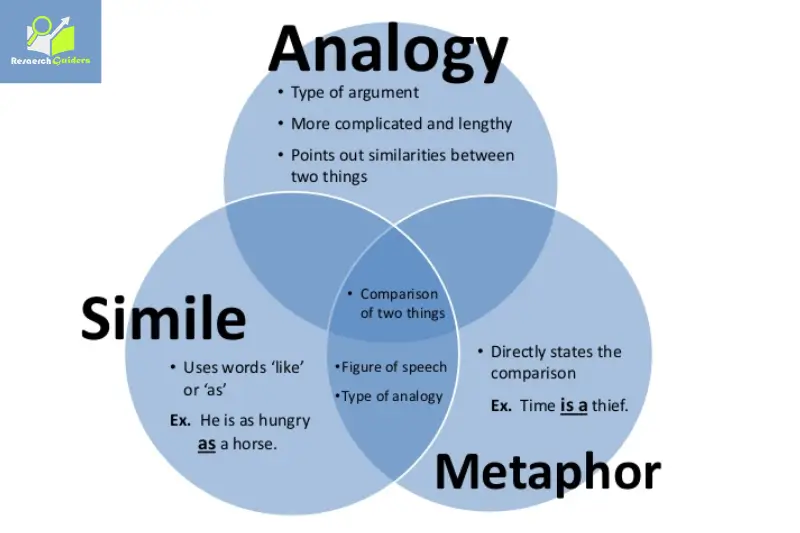
In literature, writing, and even everyday communication, figurative language is important. Words do not simply inform, but they should add feelings, clarify intricate concepts, and bring abstract notions into reality. The most popular tools in this arsenal are metaphors, analogies, and similes.
Although the three devices are similar in that they all compare two things, they are used in different contexts, and they produce varied impacts on readers. The distinction between the two is crucial to writers, teachers, learners, and anyone who wants to express themselves well and creatively.
Semantic keywords to be taken into consideration: figures of speech, literary devices, creative writing, cognitive linguistics, and comparison in writing.
After reading this guide, you will get acquainted not only with what metaphors, analogies, and similes are, but also with how to use them, giving examples, types, and writing tips, as well.
What is a Metaphor?
Definition and Explanation
A figure of speech used to describe one thing by saying that it is another is called a metaphor, although the two are not presented in real life as actual things. Pareto does not make use of such connecting words as like or as; they make a direct implication of the comparison.
For example:
- “Time is a thief.”
- Her head was a whirlwind, ever changing and unforeseeable.
- “The classroom was a zoo.”
Metaphors enable authors to develop pictures and emotions. They are frequently applied in literature, poetry, and speeches as well as in everyday language to make abstract or complicated concepts more familiar.
Conceptual metaphor theory is a cognitive linguistics theory that explains that human beings think in a metaphorical manner. We tend to know things that are either foreign or abstract at least by making comparisons with what is more real or more emotive.
Examples of Metaphors
Everyday Metaphors:
- “Life is a journey.”
- “Love is a battlefield.”
- Her voice was a blank in the cold.
Literary Metaphors:
- William Shakespeare: The world is a stage, and all the men and women are just actors.
- Robert Frost: The Road Not Taken (Metaphor about life decisions).
Visual Metaphors:
Metaphors can be used in art or in infographics to make abstract concepts, such as the concept of growth, seem visual, as a tree, or the concept of time, flow as a river.
Types of Metaphors
- Standard Metaphor – Comparison, without the words like or as.
- Example: “He is a lion in battle.”
- Implied Metaphor – implies a comparison indirectly.
- Example: She ordered around the team (A dog-like authority kind of meaning).
- Extended Metaphor – It runs through a paragraph, stanza, or any text.
- Example: A poem about life being a garden with seeds to fruit.
- Dead Metaphor – Metaphors that are no longer original.
- Example: “Time is money.”
What is an Analogy?
Definition and Explanation
An analogy is an analogy of one thing to another to define or describe a concept. The analogies are typically extended and detailed, in contrast to metaphors, which are rather short and quite emotional. They make the reader grasp complicated concepts as they are associated with the familiar.
For example:
It is the same with writing a novel: you begin with seeds (ideas), you take time to attend to those seeds, and with time you see beginning to sprout and turn out to be beautiful.
Code Reading is a foreign language; one learns to read by the patterns over time.
There are usually comparisons between words such as like, as, and is the same as. They are commonly applied in education, nonfiction, persuasion and scientific explanations.
Examples of Analogies
Everyday Analogies:
Mastering a new skill is similar to a muscle; you have to practice it every day to strengthen it.
Scientific Analogies:
The atom is a solar system, the electrons are the planets around the nucleus, like the sun.
Complex Explanatory Analogies:
It is either impossible to explain humor, or it is like breaking down a frog: you can clearly see what is going on, but it may ruin the experience.
Types of Analogies
- Synonym Analogies – Compare words with similar meanings.
- Example: Happ : Joyful:: Sad: Miserable
- Antonym Analogies – Compare words with opposite meanings.
- Example: Hot: Cold::Light: Dark
- Functional Analogies – Explain relationships or functions.
- Example: A pen is to a writer as a sword is to a warrior.
- Part-to-Whole Analogies – Compare part of a system to the whole.
- Example: Petal : lower:: ag: Boo
What is a Simile?
Definition and Explanation
A simile is a comparison of two things, which is determined by means of words like or as. It is easy to interpret similes compared to metaphors, where the comparison is direct.
- Examples: Her smile was sunshine.
- Examples: he ran like a cheetah.
Similes are very common in poetry, literature, advertising,g and in daily language to portray clear images and vividness.
Examples of Similes
Everyday Similes:
- Life is a marathon, and it is long and full of challenges.
- “He was as quiet as a mouse.”
Literary Similes:
- Shakespeare: I love her like a red, red rose.
- Similes are frequently employed as a way of evoking emotion in poetry.
Visual/Creative Similes:
Advertising or infographics: It is the Swiss Army knife in your workflow.
Types of Similes
- Explicit Simile – Direct comparison; with the words, like, or as.
Sample: “It was as black as coal at night.
- Implied Simile – This implies a comparison without the use of the words like or as.
Example: her hands played over the piano.
- Extended Simile – The comparison is extended by means of a sentence or paragraph.
Examples: He made like a lion, he is not afraid, and he is ruthless; every motion is repeated after the king of the jungle.
- Dead Simile – It is a simile that has grown to be very frequent, so it does not feel unique anymore.
Examples: As busy as a bee, As clear as crystal.
Key Differences Between Metaphor, Analogy, and Simile
| Aspect | Metaphor | Analogy | Simile |
| Definition | Direct comparison: one thing is another | Explanatory comparison: shows how two things are similar | Explicit comparison using “like” or “as” |
| Purpose | Evoke emotion, create imagery | Clarify complex ideas, teach, persuade | Clarify ideas, create vivid imagery |
| Structure | Usually brief, poetic | Often longer, detailed | Usually short, clear, and direct |
| Effect on Reader | Emotional, memorable | Logical understanding | Clear, visual, illustrative |
| Example | “Time is a thief.” | “Writing a novel is like planting a garden.” | “Life is like a marathon.” |
Tip: When you have something to express that you would like your reader to experience, then use a metaphor. In case you want your reader to grasp an idea, then use an analogy. When you need a bright visual or direct comparison, you have to use a simile.
When to Use a Metaphor
- Creative writing/ storytelling: Provides emotional coloring and vivid images.
- Example: The sunshine is the laughter in her.
- Poetry: makes vivid visual pictures and emotion.
- Speeches or slogans: Memorable and memorable ideas are striking.
When to Use an Analogy
- Education: Break down the abstract concepts to simple terms.
- Non-fiction & science writing: Explains how things work or work-related concepts.
- Examples: An algorithm is a recipe; follow the steps, and you will have the same result.
- Professional communication: Assists indecision-making, presentation, or training.
When to Use a Simile
- When to Use a Simile. To make comparisons easier and understandable to the reader.
- To create clear and vivid pictures in a short time.
- To create a visual effect in poetry, prose, or advertising.
Common Misconceptions
- Metaphor vs Analogy: Metaphors are confused withanalogiesy. A metaphor is an emotional appeal, andan analogy is a logical one.
- Metaphor may be an analogy: When carried over to the description step-by-step, a metaphor may serve as an analogy.
- Simile vs Metaphor: Similes contain the words like and as but metaphors do not.
Benefits of Understanding These Devices
- Develops critical thinking and understanding: The ability to see relationships among ideas enhances understanding.
- Enhances writing and speaking ability: Metaphors, analogies, and similes will help increase the level of communication.
- Stimulates imagination: Stimulates individual expression and imagery.
- Applicable in teaching and work-related situations: Assists in articulating complicated concepts in a short time.
Practical Tips for Crafting Effective Metaphors, Analogies, and Similes
- Map the emotional centre: Find the emotion or idea and then form the analogy.
- Apply two or more senses: Incorporate sound, touch, smell, taste, or sight.
- Take the comparison to its limit: Go deeper but make it approachable.
- Invert expectations: Do something unexpected by using unusual comparisons.
- Check resonance over logic: Resonance can be experienced more in creative writing than in literal work.
Conclusion
Any writer cannot do without metaphors, analogies, and similes. They enable you to create emotion, explain ideas, and paint bright images in your mind. Knowing the difference between them will assist you in the right tool you should use in your writing mission:
- Metaphor: To appeal to the feeling and imaginative pictures.
- Analogy: To explain and be understandable logically.
- Simile: To make direct and visual comparisons.
The next time you write, yourself, you should ask yourself the following questions: Do I want my reader to feel this idea, understand it,t or have a clear visual? It will be the answer that leads you to the ideal literary device.
Must Read:
Project Management Assignment Help for Academic Success
How to Write a DBQ Essay | Step-by-Step Guide, Examples, and Tips
15 Easy Thematic Statement Examples to Improve Your Writing