

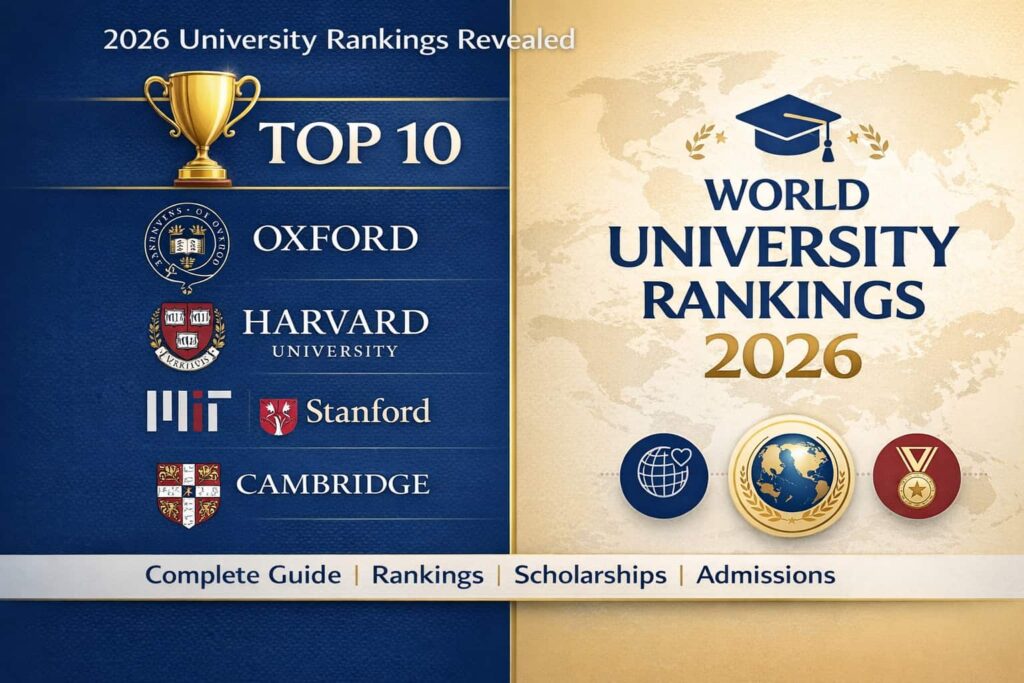
Academic excellence has become a worldwide trend with students in Tokyo and Toronto, Mumbai and Melbourne, among others, competing to secure a place in the top universities in the world 2026. The ranking of global universities in 2026 is not just a list anymore, but a dream, aspirations, and a life-changing chance for millions of young scholars. It is necessary to understand these world university rankings in the year 2026 to make a wise investment in good education; be it a student planning his academic future, a parent who wants the best education to his child, or an educational consultant who is guiding the future generation to success.
Decoding the World University Rankings: The Science Behind the Numbers
The 2026 ranking of the best universities is conducted by conducting stringent assessment exercises that analyze various aspects of institutional excellence. Sophisticated methodologies used by organizations such as Times Higher Education, QS World University Rankings, and Academic Ranking of World Universities are quantitative metrics that are used in conjunction with qualitative measures. These world university rankings 2026 use the quality of teaching in terms of student-to-faculty ratio and surveys of learning environment, volume and impact of research in terms of publication and citation, knowledge transfer in terms of industry income, patents, and international perspective in terms of student, staff, and research partner diversity.
The methodology normally assigns a certain weight to various performance indicators. Academic reputation normally takes between thirty and forty percent of the total mark, which is collected by massive surveys in which thousands of academicians all over the world determine which institutions produced the best work in their areas. The citations in research have been used to gauge the impact and the influence of published research, defining the number of times in which scholars mention the research of an institution in their literature. Faculty-to-student ratio can demonstrate the extent to which students are given personalized attention; where ratios are lower, the instruction and opportunities to mentor the students are more personalized. International student faculty ratios mean cross-cultural learning and cross-cultural learning settings in which graduates are educated to work in interconnected professional environments.
Knowledge of these ranking systems can make students consider the numbers in the headlines and determine which indicators are most important in their personal situations. A university with high research citation rates may be the best place of doctorate students, whereas undergraduate students may be interested in teaching quality rates. The best universities in the world are always doing well through all the classifications; however, looking at the strengths in detail enables the students to make quality choices in terms of personal study goals as well as career goals.
The Global Elite: Highest Ranked Universities Leading Educational Excellence
The list of the top ten of the world university rankings 2026 provides the list of the institutions that managed to maintain the leading positions throughout decades of investment, innovation, and the maintenance of the principles of excellence. The University of Oxford stays in the first position in the world rating, and this fact proves the fact that even long traditions ought to be capable of coexisting with the latest research devices. The one thing that has remained to date about Oxford is the department of tutoring, where students can enjoy weekly sessions with renowned academicians in a way that they can think critically and examine individuals. This feat is impossible in traditional lectures. The university libraries have over thirteen million books that place research activities in the humanities, sciences and social sciences areas unprecedented in other institutions.
The case of Harvard University symbolizes the American education advantage that has forty billion dollars in endowment, Nobel-winning professors, and alumni of Harvard who have become presidents, judges of the Supreme Court and Fortune 500 executives. The law, medical, and business professional schools of Harvard are international models, and its undergraduate college has a selectivity rate of less than four percent, which only accepts the best of the world’s students. Massachusetts Institute of Technology has revolutionized the sphere of technology education, giving rise to such inventions as email and modern artificial intelligence, where the culture within the institute provides the concept of entrepreneurship and the practical application of theoretical experience.
The availability of Stanford University in the Silicon Valley is mutually beneficial and symbiotic as the university and the companies have professors and student respectively, as advisors to the technology giants and employees, respectively, in identifying the future of digital technology. The interdisciplinary nature of the university brings together engineers, designers, and business strategists, which is similar to the innovation ecosystems in the real world. Cambridge University has a history of scientists like Newton, Darwin, Hawking, and has won over a hundred Nobel Prizes, and the current research covers quantum computing, genomics, and climate science. Its student body is not very high, with a little more than two thousand students, and the output of scientific work is greatly overproduced through their specialization in physics, chemistry, and engineering.
Top 10 Highest Ranked Universities Worldwide 2026 – Comprehensive Overview
| Rank | University Name | Country | Overall Score | Teaching | Research | Citations | Intl. Outlook | Intl. Students % |
|---|---|---|---|---|---|---|---|---|
| 1 | University of Oxford | United Kingdom | 96.8 | 94.2 | 99.1 | 99.8 | 96.5 | 43% |
| 2 | Harvard University | United States | 95.9 | 95.1 | 98.7 | 99.2 | 82.1 | 25% |
| 3 | Massachusetts Institute of Technology (MIT) | United States | 95.2 | 92.8 | 97.9 | 99.5 | 90.2 | 34% |
| 4 | Stanford University | United States | 94.9 | 93.5 | 98.2 | 99.1 | 79.8 | 23% |
| 5 | University of Cambridge | United Kingdom | 94.6 | 93.9 | 98.5 | 98.7 | 95.8 | 39% |
| 6 | California Institute of Technology (Caltech) | United States | 94.3 | 91.7 | 96.8 | 99.9 | 88.5 | 31% |
| 7 | Imperial College London | United Kingdom | 92.8 | 90.4 | 96.2 | 97.8 | 97.3 | 61% |
| 8 | ETH Zurich | Switzerland | 92.1 | 89.8 | 95.7 | 96.4 | 98.9 | 41% |
| 9 | University College London (UCL) | United Kingdom | 91.7 | 89.2 | 95.3 | 96.9 | 97.1 | 54% |
| 10 | Princeton University | United States | 91.4 | 94.6 | 94.8 | 98.2 | 78.4 | 28% |
From the top 10 universities in the world Imperial College London is the only institution that is specialized in science, engineering, medicine, and business, developing focal excellence at the boundary of the disciplines, to address the multifaceted global problems. ETH Zurich embodies continental European adherence to technical education and has always been ranked the highest-rated university in the non-English-speaking world, with a strong emphasis on architecture and engineering.
University College London was the first university in England to provide secular education, and now provides a full range of courses, including archaeology and neuroscience, yet with special emphasis on medical research. Princeton University is the final in the top ten with its own specialization in undergraduate instruction, together with graduate research of global standards, and the creation of close learning communities that allow students to collaborate with major scholars.
For students aspiring to join these elite institutions, professional guidance can significantly enhance application success. Comprehensive support services available at ResearchGuiders help candidates navigate complex admissions processes, craft compelling personal statements, and position themselves as competitive applicants for the best universities in 2026.
Australia’s Academic Powerhouses: University Ranking Australia Excellence
The Australian landscape of university ranking shows how the country has attained an impressive upswing in the international education markets, and several institutions are now well established in the top one hundred of the world’s educational markets. The University of Melbourne pioneers the Australian tertiary education, and it has always placed it on the top position in the country and even across the world in competition with European and American Universities. A unique educational system in Melbourne is the focus on undergraduate programs that are broad, which is followed by specialization to generate graduates with a wide range of skills that are applicable in the fast-changing employment markets. The medical and engineering faculties of the university draw research funding of hundreds of millions each year and do revolutionary work in the fields of cancer treatment, renewable energy, and artificial intelligence.
Australian National University enjoys the advantage of being in Canberra and having close relations with government departments, diplomatic missions, and policy institutes, which offer it special research and networking opportunities. The research school model at ANU enables advanced students to collaborate with the top academicians in carrying out projects that have an impact on national policy and international relations. The focus on research excellence that the university promotes global scholars into the institution, resulting in a variety of intellectual communities where ideas and disciplines/cultures cross-pollinate. Founded in eighteen fifty, the University of Sydney has the opportunity to enjoy the prestige of a long history with the current research facilities, especially in the health sciences, where related teaching hospitals offer some of the best clinical training facilities in the world.
University of New South Wales has also established specific competence in engineering and technology, whereby industry partnerships have made sure that the curriculum is kept at par with the demands of the employer and the latest technological trends. The co-operative education programs at UNSW combine classroom work with working conditions, which provide students with a competitive edge in the graduate employment sectors. The multi-campus system of Monash University, which covers Australia and other global locations in Malaysia and South Africa, offers globally integrated education to students. Queensland University uses the subtropical climatic conditions and natural habitats of Brisbane to facilitate its success in marine biology, environmental science, and tourism management, as it offers comprehensive programs in traditional disciplines.
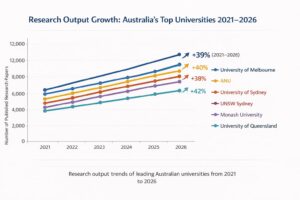
Research Output Growth: Australia’s Top Universities 2021-2026
The post-study work visa arrangements offered to international students are especially appreciated, according to which they can have two to four years of working right upon graduation, depending on the degree of qualification. This policy allows working experience in Australian industries, which increases the employability at the international level and offers the possibilities of long-term settlement to people willing to reside permanently. Australian universities have spent a lot of money on student support infrastructure and realised that academic achievement is reliant on holistic wellbeing that includes mental health, financial stability, and social integration. Counseling services, career guidance services, language support services, and cultural integration programs, among others, all provide international students with an opportunity to succeed personally and in academics.
The quality assurance systems in the Australian education system, such as the Tertiary Education Quality and Standards Agency, ensure that all institutions have high standards in their quality assurance systems to maintain the value of the degrees in the international employment and advanced education markets. Australian credits are accepted internationally, and graduates get their opportunities in Asia-Pacific, Europe, and America. Academic excellence coupled with multicultural settings, appealing lifestyle, and post-study prospects make Australia a very appealing destination among the students who look forward to the world-class education without involving the traditional North American and European markets.
United Kingdom: Top UK Universities Blending Heritage with Innovation
The top UK universities are a special tradition of education in which medieval colleges are found alongside the most advanced research institutes, and traditional libraries are side by side with electronic education. Oxbridge is Oxford and Cambridge, two institutions that have reigned over the world for the last eight centuries but keep on adapting to meet their present-day challenges and remain relevant in the fast-evolving knowledge economies. The collegiate system at Oxford splits the university into thirty-nine separate autonomous colleges with unique character, traditions, and academic focus to establish small communities within the bigger institutional structure.
Oxbridge education is unique to the traditional university model, where students are taught each week by subject specialists either one-on-one or in small groups, and are challenged and criticized to sharpen and refine their minds in Socratic dialogue. This rigorous pedagogical strategy builds analytical rigor, argumentative ability and intellectual confidence that benefits the graduates in the course of their professional careers. The scientific tradition of Cambridge leads to contemporary research in science in areas such as quantum computing and synthetic biology, with spin-off companies based at the university creating billions of dollars in economic benefits and enhancing human capability and knowledge base.
Imperial College London is an institution that specializes in science, engineering, medicine and business, which has developed specific knowledge in disciplines where interdisciplinary partnerships are applied to global problems such as climate change and pandemic preparedness. The location of Imperial in South Kensington puts students in the middle of world-leading museums, such as the Science Museum and Natural History Museum, and being near industry leaders in the field of finance, pharmaceuticals, and technology offers opportunities of internship and employment. In nineteenth-century England, the University College London was the first college to practice radical inclusivity by admitting students without any restrictions based on religion, gender, or social status, and this idea now comprises what is thought to be the key principles of contemporary higher education.
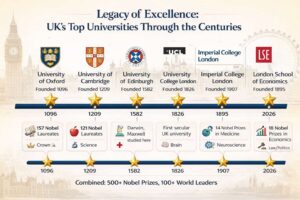
The scope of UCL is what sets it apart compared to more specialized schools, with a wide range of programs in arts, sciences, engineering, and humanities, but with special expertise in neuroscience, architecture, and economics. The London School of Economics, a social sciences centre, has had more world leaders per capita than possibly any other school, with alumni having been at the helm of governments and central bank boards, shaping the world economic and political environments. Edinburgh has been the intellectual heart of Scotland, where alumni such as Darwin, Maxwell, and Adam Smith have contributed, and who are still present today through outstanding work in informatics, medicine, and research in artificial intelligence.
King’s College London is a leader in the health sciences sector and has one of the largest medical schools in Europe, but it remains strong in humanities and other social sciences. The industrial legacy of Manchester University is reflected in the modern-day greatness in materials science, engineering, and computer science, with the National Graphene Institute at the forefront of the research into groundbreaking materials with applications in the electronic and healthcare realms. Bristol University offers good science courses with great humanities departments, and Warwick has already become a force in the field of business, economics, and data science despite its nearly century-old foundation (nineteen sixty-five).
According to a comprehensive analysis from Times Higher Education World University Rankings, UK institutions maintain competitive advantages through research intensity, international collaboration, and sustained investment in facilities and faculty despite recent funding pressures and political uncertainties surrounding Brexit.
United States: Top USA Universities Dominating Global Education
The top USA universities can be considered as examples of the diversity and the scale of American higher education, where small liberal arts colleges can be located in the same domain as giant research universities with over fifty thousand students. The Ivy League is the prestige of the past and the excellence of the present. Still, these eight universities only form a small part of the highest-ranking universities in America. The forty-billion-dollar endowment of Harvard University allows financing financial aid programs that guarantee gifted students are able to attend university regardless of the amount of family income, and generously supplies international scholars with financial aid. The professional schools of Harvard have an international benchmark; the medical school is the first to perform research in the field of genetics and immunity, the law school is the originator of legal thought and practice, and the business school generates executives of large multinational corporations.
Yale University integrates residential college systems that build small communities with graduate programs that are of the highest caliber in law, management, and medicine. Humanities courses, especially in history and English literature, are viewed as some of the best in the world, and science departments have generated ground-breaking studies in chemistry and molecular biology. Princeton emphasizes undergraduate education, although it has strong graduate studies, and the student-faculty ratio allows a unique access to the famous scholars. Princeton’s mathematics and physics departments have spawned several Nobel Prizes and Fields Medalists, and follow in the footsteps of both Einstein and other twentieth-century giants.
Columbia University’s New York City location offers incomparable access to media, finance, arts, and culture, and the journalism school is known the world over as the training ground of the profession. The University of Pennsylvania is a mix of excellent liberal arts and pre-professional programs in business (Wharton), engineering, and nursing that make graduates immediately professionally effective. The open curriculum at Brown University gives the greatest freedom to students who are permitted to draw their own personal educational path and intellectual exploration without strict distribution mandates. At Dartmouth, the focus on undergraduate teaching in a small school environment does not eliminate some graduate programs, as it builds communities in which students and professors develop enduring relationships.
Top USA Universities by Region 2026 – Geographic Excellence Distribution
| Region | University Name | Global Rank | Overall Score | Tuition (USD/year) | Acceptance Rate | Median Starting Salary (USD) | Campus Setting |
|---|---|---|---|---|---|---|---|
| Northeast | Harvard University | 2 | 95.9 | $54,269 | 3.2% | $89,700 | Urban |
| Northeast | Massachusetts Institute of Technology (MIT) | 3 | 95.2 | $57,986 | 3.9% | $98,500 | Urban |
| West Coast | Stanford University | 4 | 94.9 | $58,416 | 3.7% | $95,200 | Suburban |
| West Coast | California Institute of Technology (Caltech) | 6 | 94.3 | $60,864 | 3.4% | $92,300 | Suburban |
| Northeast | Yale University | 8 | 92.5 | $62,250 | 4.5% | $83,400 | Urban |
| West Coast | University of California, Berkeley | 12 | 90.8 | $14,312* | 11.4% | $76,800 | Urban |
| Midwest | University of Chicago | 15 | 89.7 | $63,801 | 5.4% | $81,500 | Urban |
| South | Duke University | 18 | 88.4 | $63,054 | 6.2% | $79,200 | Suburban |
| West Coast | University of California, Los Angeles (UCLA) | 20 | 87.6 | $13,401* | 9.2% | $74,300 | Urban |
| Southwest | University of Texas at Austin | 45 | 78.9 | $11,698** | 29.1% | $68,900 | Urban |
Ivy League prestige is matched by Ivy League public land-grant mission, in which Cornell University offers unique programs and degree programs in agriculture, hospitality, industrial relations, as well as the traditional liberal arts and sciences. The example of the University of California system shows that even public universities can be competitive against the best private universities, and Berkeley and UCLA, in particular, are leaders in the scientific and engineering programs, as well as in professional programs. The legacy of political activism in Berkeley is now manifested in the active participation of students in social justice matters, whereas the academic programs ensure the research quality in the broad spectrum of disciplines, including computer science and literature.
The Silicon Valley location of Stanford generates unmatched entrepreneurship and technology job prospects, fosters student entrepreneurship, and offers resources such as mentorship and up to seed funding. Computer science and business schools have given rise to businesses like Google, Yahoo, and Instagram, and have generated venture capitalists and startup founders who are defining the economies of innovation worldwide. The cornerstone curriculum at the University of Chicago makes sure that all undergraduates are exposed to the traditional texts and the basic questions, and professional schools of law, business, and medicine carry reputations of intellectualism globally.
Duke University is a blend of southern appeal and educational rigor, and more so in the sphere of medicine, with the affiliated Duke University Health System being considered as one of the leading academic medical centers in America. The journalism and business schools at Northwestern University are among the best in the country; the engineering school has grown with a special edge in biomedical engineering and materials science. Johns Hopkins University, which is not an Ivy League school, competes with any other university in terms of research funding, especially in dominating biomedical research with its medical school and Bloomberg School of Public Health.
Expert guidance becomes essential when navigating American university admissions’ complexity, from standardized testing strategies to essay writing to scholarship applications. Professional services like those available through ResearchGuiders thesis writing services support students throughout their academic journeys, from undergraduate applications through doctoral dissertations.
How Global University Rankings 2026 Influence Admissions and Scholarships
The international university rankings 2026 have a trickle-down impact on the markets of international education, affecting application rates, scholarship funding, and employment rates. The leading universities will get applications by a multiplier many times over compared to those with low ranking, with top universities at times getting fifty thousand applications to fifteen hundred freshman classes, leading to a three percent acceptance rate. This high selectivity allows universities to develop student bodies of brilliant talent and diversity, which in turn improves their educational settings and supports their luxurious reputations.
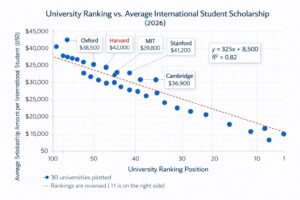
Rankings are common as quality proxies in scholarship committees, both governmental and private, as they make allocation decisions based on funding. Scholarship schemes operated by countries as far as Malaysia to Saudi Arabia tend to limit their funds to those universities that exceed certain ranking certifications because they are aware that any investment in international education must focus on those institutions that have a proven excellence. At school, 4-year colleges with a high ranking, merit-based scholarships tend to be higher, in part due to the bigger endowments they have, and in part due to the intense competition they face with high-ranking high schools. Needs-based financial aid is also more generous at well-ranked universities, especially in the United States, where elite institutions have made it a point to grant all admitted students their full demonstrated need.
University Ranking vs. Average International Student Scholarship (2026)
Prestige may influence career performance with both employers and employees in competitive industries such as consulting, investment banking, and technology recruiting, massively and at times exclusively. The consulting companies, such as McKinsey, Boston Consulting Group, and Bain, have target school lists made of mostly the top twenty schools, and they interview only at these schools. The same is the case with investment banks, which usually focus on recruiting at high-ranking universities, as they believe that admission selectivity acts as a preliminary filter when it comes to intelligence and motivation. Technology firms are sometimes more meritocratic, but continue to pick up the best computer science students at Stanford, MIT, Carnegie Mellon, and Berkeley.
Graduate and professional schools have been known to weigh up undergraduate institution reputation in assessing application but in this case, less weight is placed on the individual achievement, such as grades, test scores, research experience and recommendation letters. Medical schools understand that a student who scores well in a university with a high ranking must have had a stiffer competition as compared to the one who scores the same grades in another university. Law schools are looking at LSAT scores and GPAs, but are also looking at undergraduate institution selectivity when forecasting candidate potential. Business schools that consider MBA applications have work experience as their most valued asset, but prestigious undergraduate degrees are metrics that are respected as indicators of competence and the quality of the network.
Rankings give international students another consideration. The scholarship programs in some countries also only offer scholarships to students enrolled in universities that are ranked above some specified ranking levels, thus rendering the attendance of students enrolled in lower-ranked universities unaffordable to students who need such assistance. The university ranking has been taken into consideration in work visa policies in nations such as Australia and the United Kingdom, where graduates of higher-ranked institutions are given more points under immigration systems based on merit. All that they imply is that to international students, a high-ranked university would not only influence the quality of education but also the post-graduation immigration and employment.
To gain a fine understanding of the impact made by the global ranking positions on admissions competitiveness, scholarship distribution, visa-granting rates, and post-graduation career paths, refer to the extensive professional manual that will expound on the effects of university rankings on admissions, scholarships, visa-grant rates and career outcomes.
According to research published by QS World University Rankings, the correlation between university ranking and graduate employment outcomes has strengthened over the past decade, suggesting that rankings increasingly influence labor market perceptions and hiring decisions globally.
Beyond Rankings: Strategic Factors for Choosing Your Ideal University
Although the best universities 2026 lists are a source of valuable information, they must inform rather than tell and guide university choice. What benefits one student is what will be totally wrong to another based on the learning styles choice, career goals, monetary status, and personal principles of the learner. The future students should take into consideration the strength of the academic programs in their desired major, since overall rankings of the university do not necessarily translate to the excellence of the department. A university that is ranked number 50 in the general competition may have the best program in your major field, and it will be much better than a top-ten school with average services in the same field.
Geographic location is important in influencing student experience as well as post-graduation opportunities in ways that rankings fail to reflect. Urban campuses such as NYU, UCL, and Hong Kong University have access to internships, cultural activities, and varied populations. In contrast, rural colleges such as Dartmouth and St Andrews have close-knit communities and nature with less to distract students from their studies. Climate factors should be taken into account more than potential students might have expected, because four years living in a permanently wet climate or in a desert climate influences the mood and productivity daily. Living close to family and support systems is essential to some students who excel in the presence of emotional backing. In contrast, others excel because of their independence, which is obtained by studying away.
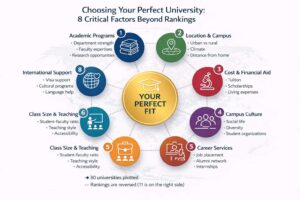
Monetary factors go far beyond tuition to include living expenses, which are extremely different depending on location. The apparently cheap forty-thousand-dollar college charges in an admittedly costly New York or London can end up costing greater than sixty-thousand-dollar college charges in a less expensive midwestern American city or a regional town in Australia. Knowledge of the total cost of attendance, such as room, board, books, transportation, health insurance, and personal expenditure give realistic image of financial obligations. Exploring scholarship opportunities, work-study jobs, teaching assistantships, and part-time jobs can be used to determine the affordability beyond the sticker prices.
The culture of the campus should be carefully assessed by visiting the campuses when feasible, taking virtual tours, speaking to the students of the campus, and reaching out to the alumni. In some colleges, academic competition is valued, and curriculum grading has a high level of pressure, whereas in others, there is a culture of collaborative learning where students want each other to succeed. Social places are different compared to Greek life-occupied campuses with more mixed social networks. Athletic culture runs the spectrum of Division I sports, taking over campus life, to more moderate ones in which athletics is one of the numerous extracurricular activities. The political inclinations, religious inclinations, and demographic makeup all add to the everyday experiences that rankings cannot quantify but have an impact that is significant in terms of satisfaction and success.
The alumni networks and the quality of the career services are the key contributors to post-graduation transitions. Universities that have good corporate networks provide internship and employment opportunities with employers taking on campus by organizing career fairs and career seminars. Massive Networks of alumni provide open access by linking, mentoring, and informal job recommendations that official applications can hardly equal. Researching placement statistics in your major of interest, average graduate earnings, starting salaries in certain majors, and organizations recruiting at your university provides a look at the results of your career that the aggregate ranking does not reflect.
There is a wide range of teaching quality in different institutions, where some colleges focus on research at the expense of undergraduate teaching, whereas others focus on teaching excellence. Student-faculty ratios are crude estimates of classes and accessibility of professors, but actual experiences are limited to particular departments and levels of courses. In other universities, certain undergraduate courses are taught by teaching-oriented faculty, and research faculty normally teach graduate seminars, whereas in other universities, all faculty are expected to perform excellently in teaching and research. Exploration in the area of teaching assessments, interviews with existing students, and exploration of academic advising models demonstrate university priorities in the area of undergraduate schooling.
Undergraduate research opportunities also make universities highly distinguishable, especially when one is planning to attend graduate school in the sciences or social sciences. Other schools incorporate undergraduates into research by faculty as early as freshman year, whereas other schools use graduate students only. Access to research funding, access to labs, and advice from professors pursuing state-of-the-art projects will be priceless training in the field of doctoral programs and research. In the case of students who are more focused on the professional world than academia, doing comprehensive research might be less important than an internship program and industry contacts.
Your Path to Academic Excellence Starts with Informed Decisions
Top Universities in the world 2026 rankings shine a light on the avenues to academic excellence, displaying the ancient halls of Oxford, the innovation centres of Stanford, the multicultural campuses of Melbourne, as well as the technological perfection of ETH Zurich. The top universities have shown a long-term dedication to teaching, research, and contribution to society, and provide an environment where smart students and scholars of all continents engage in promoting human knowledge and human capability. Knowledge of these rankings, their methodologies, and their limitations can help the students make up-to-date decisions in accordance with personal objectives and situations.
The improvement in the world ranking of Australia is credited to the strategic investments in research infrastructure and international student experience, which makes the country a more desirable place of study to Asian students who are in need of English language learning in addition to a multicultural environment and post-study experience. The leading universities in the UK have been able to sustain competitive edges with regard to research intensity and international cooperation in spite of the recent difficulties, whereas American universities have been able to exploit massive endowments and institutional heterogeneity to take up the highest positions in the global ranking. The latter provides each region with distinctive benefits in terms of educational philosophy, cultural experiences, and career advancement.
Rankings, however, are only a single facet of university choice. The best universities 2026 for you as an individual person are based on academic interests, financial capability, preference of learning style, career goals, and personal values, which cannot be fully portrayed through any ranking system. Research into particular program strengths, campus cultures, location characteristics, and career support systems gives a necessary background to the numerical scores. Campus visits, meeting current students and alumni, and a frank evaluation of priorities, will help to identify the institutions that are compatible with personal needs.
The admissions to the best colleges require effective planning, compelling writing through personal statements, outstanding academic qualifications, and, in most cases, expert advice to maneuver successfully. Competitive candidacy is vital in knowing how to apply and meet admission requirements, scholarship application dates, visa requirements, and application strategies. Professional educational consultants are of priceless help in such complicated processes, starting with the choice of university to attend up to the final decision of enrolling to a college.
What you spend on your education at higher levels determines not only professional paths, but intellectual growth, worldviews, and self-growth that is applied in solving problems in social networks and worldviews. The place of spending these formative years is worth serious research, deliberation, and professional advice in negotiating the intricate international education systems. You indeed want to do some groundbreaking research, start some innovative startups, achieve professional excellence in medicine or law, or you have some intellectual curiosity in the field, and there is a school that fits exactly what you want.
Start your experience on the path to academic excellence with all the information, plans, and the belief that you can excel in the best universities of the world. The possibilities of the best universities 2026 are far beyond the classroom and the laboratory and encompass global networks, cultural experiences, and lifetime-long personal transformations.