

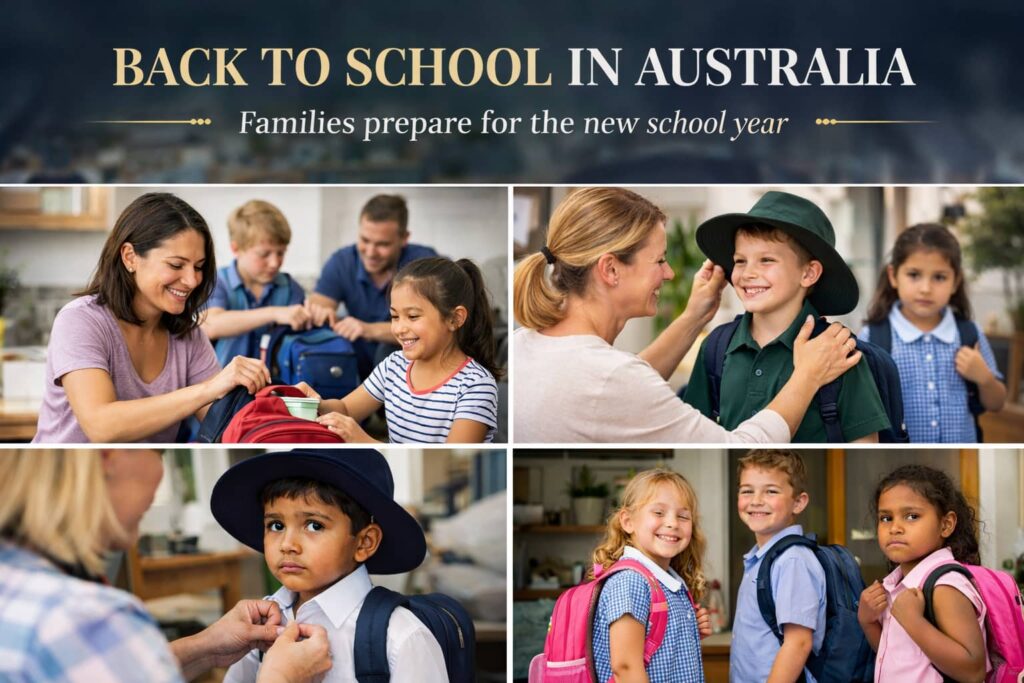
With the end of the summer holidays and the beginning of the new school year, families across Australia are adjusting to the familiar feelings of excitement and nervousness. The first day of school is a significant moment, whether children are entering a classroom for the very first time or are experienced students. But what is specifically curious about this transition in 2026 is that the preparation for the first day of school appears to be dramatically different in various respects based on the location of families in this large continent.
When Does School Actually Start in Australia?
Such a diversity of school start dates Australia in various states and territories is one of the most significant differences that families have to face. Although the minds of most Australians would think that schools all around the country start on the same day, this is not the case. Victorian students are also among the first to start going back in 2026, when classes start on January 28. At the same time, Queensland and South Australian students have a common starting date (January 27), which sets an interesting interaction with the relatives of other states.
New South Wales is even more subtle by offering a different division structure. In the Eastern Division, school opens on January 30, but the families in the Western Division have a long holiday, and the year at school does not commence till February 6. This one-week deviation is because of practical considerations; the Western region is much warmer in this period of the year, and the fact that they are not starting at the hottest time of the summer months.
Tasmania has been notified of the latest, and students will not go back until February 5. The Australian Capital Territory and Western Australia are in the middle of the pack, both starting on February 2, but with a staggered system of intake, with new students starting on January 30 to facilitate their orientation into the system.
The Emotional Landscape of School Preparation
Possibly the most difficult emotional experience of both parents and children is behind every school bag full of items and the freshly ironed uniform. The first day of school- the first day of kindergarten or the first day of the new school year is filled with both uncontrolled excitement and outright anxiety. Fathers and mothers often have to make their way through their personal feelings, attempting to help their children in this serious change in life.
It can be especially overwhelming in the case of a family that has children who are just entering school. These students are young, and they are on a path that will define their social, academic, and personal autonomy as they grow up. Some parents complain of mixed emotions of both pride about the growth of the child and sadness about this move to independence.

[Image Idea: Close-up of a parent’s hands helping a child button up their school uniform, showing the tender moments of preparation]
A curious variety of reactions toward the looming school year is exhibited by children themselves. Others skip around with excitement and impatience to see their friends and teachers once more. Others are concerned with all sorts of things taking place in school life – befriending people, coping with school assignments, knowing where their classroom is, or just spending a lot of time off with their parents.
Learning theorists stress that there is nothing wrong or unnatural in all of these feelings. The trick is that families should embrace and deal with these emotions instead of rejecting them. When children understand that it is possible to hear them and help them express their concerns, it will be easier to cope with the real experience of the beginning of school.
Practical Steps for Preparation
Whatever the actual date of school commencement, all over Australia, families are undergoing the same ritual of preparation, which makes the transition easier. Among the best approaches is changing sleeping schedules in the weeks before the first day, but gradually. Having slept relaxed in the current holiday bedtime, and suddenly having to expect children to be willing to wake up early makes people experience unwarranted stress and fatigue.
Sleep specialists recommend beginning this adjustment at least two weeks before school starts, shifting bedtimes and wake-up times by 15 to 30 minutes every few days. This slow system gives the inner time of children the chance to readjust themselves instead of having to confront a sudden shift during the first day of school.

Preparation is also another important element that entails introducing children to their new or returning school setting. Numerous schools in Australia organise orientation programs or open days that are aimed at making the families familiar with the physical environment and the teachers before the first day of school. All these visits are intended to accomplish several tasks: children get to visualize the setting of their daytime, the fear of the unknown diminishes, and parents get a chance to ask questions and get to know the educators.
In children who are attending first grade, the practice of basic independence skills can be priceless to their families. Even basic chores, such as opening lunchboxes, handling drink bottles, putting on shoes, and going to the bathroom by themselves, become imperative at a time when children are going through school days with no parental supervision at all. The time taken in the pre-school weeks practicing these skills can also make huge improvements in the children in terms of confidence.
The School Supplies Challenge
Buying school supplies is not only an exciting experience but also a possible cause of stress for the Australian family. This procedure will appear different in case children study in public or private schools, and uniforms, technology, and other general supplies have different demands. Most families end up in the midst of a large crowd of other customers in packed stores around the end of the first week of January and fight to get the best deals and make sure they stock everything on their sometimes long supply lists.
This is especially a problem for families with growing children because of uniforms. Parents are left buying completely new wardrobes since children have increased massively during the summer vacation. The cost of school uniforms may be quite high, especially including sports uniforms, sun protection hats, and special shoe specifications.
In the past few years, the technology needs have changed significantly, with some schools anticipating students to be in possession of tablets or laptops. Although this shift to the digital world is a benefit to the learning process, it also presents high costs to school preparation. Not only does the family need to buy devices, but they also need to be provided with proper cases, home internet connection, and, in some cases, a particular educational software or subscription.

Supporting Children’s Emotional Readiness
Otherwise, the emotional school preparation of children should be given serious consideration, besides the practical arrangements. According to education professionals, having a positive attitude towards school, even when parents experience nervousness about school, affects the perceptions of children towards this transition to a large extent. Children are extremely sensitive, and they tend to reflect whatever they see in their parents.
It is possible to discuss the opportunities of reading books about starting school together. Numerous children’s authors have been busy writing stories particularly meant to make the young readers digest their emotions about entering school. Such stories often have relatable characters who are going through the same experience, and it provides children with vocabulary to convey their own worries and demonstrate to them that their concerns are not unique and that others also have them.
Establishing consistent morning and evening routines before school begins, it aids in the establishment of predictability and security. Children are able to know what to expect every day, and thus feel more in control and less anxious. These routines do not have to be complicated – even simple routines, such as wake up, breakfast, brush teeth, get dressed, pack bag, are a way of providing structure that children feel comfortable in.
Regional Considerations and Climate Challenges
The variations in the opening dates of schools in Australia are not simply a matter of administrative whimsy, but they are the result of actual climatic changes that influence the capacity of students to learn comfortably. An example of decisions directly responding to temperature extremes is the decision of western New South Wales to delay school start due to the potential danger of early morning travel and difficulty in classroom learning due to the lack of cooling.
In the year 2026, certain areas are experiencing specific difficulties in the form of excessive weather. Some areas in Victoria and South Australia have recorded temperatures of close to 50 degrees Celsius, leading to school closures and relocation. These unforeseen interruptions provide another difficulty to the families that are attempting to prepare to school year, managing the practical problem of extreme heat.

In the case of families in these afflicted areas, preparation does not only entail the commonly available school supplies, but also contingency planning in case of heat-related inconvenience. The parents should make alternative childcare plans, learn school heating policies, and provide children with proper sun protection and hydration plans.
First Day Realities
The families around Australia will get to experience it differently due to the location, age, and personality of their children, and their respective school experiences. Nonetheless, there are factors that are always constant irrespective of these variables. Teachers and other staff members of the schools plan carefully on how to welcome these arrivals because they know that the first day is a preview of what is to come in the rest of the year.
A lot of schools stagger the time of entry or adopt buddy systems that group new students with older and more experienced students who would guide the new students to cope with the new routine. Educators normally arrange interesting and warm activities that are meant to make the children feel at ease and eager to be in their classes instead of leaping directly to the academic tasks.
The first day of school can be more emotionally difficult than expected when it comes to parents. When I see children go through school gates, especially on the first day, it provokes strong emotions concerning their development and the independence that they gain. Schools understand this and usually give parents a chance to loiter around and take pictures, and get assurances from the school staff on how the drop-off and pick-up will be conducted.
Looking Beyond the First Day
Although highly concentrating on the first day preparation, education experts also state that the first day in school is only the tip of the iceberg. It usually takes weeks before children can adapt to new schedules, social life, and educational standards. In the process of this adjustment, family members may help children by keeping up with their routines, expressing interest in their school lives without harassing them with inquiries, and keeping in touch with the teachers.

Naturally, children have good and bad times within the first weeks of school. There are days they will come home full of excitement about their new friends and activities. On other days, they may be exhausted, overburdened, or lost in some section of school life. Such variability does not mean they are having issues – it is just a sign that children are going through a process of huge adaptation.
Parents can contribute by ensuring that there is some room in which children can unwind after school. Although, understandably, one needs to know more about their day, some kids require time to be silent before they are willing to tell. Certain families may discover that casual discussion during snack time or when they are engaged in a mutual activity within the family provides more information than informal questioning right after school.
The Bigger Picture
With families in Australia gearing up for the 2026 school year, they are engaging in a ritual that links millions of individuals every year. Although the dates of opening vary, the climate factor is taken into account, and certain school needs can vary, the hopes are generally the same. Children are desirable to be happy, safe, and capable. They want their children to make friends, find new interests, and gain confidence in their abilities.
These are the same goals of teachers and school administrators, who strive to provide friendly conditions in which every student can perform well. They have come to realize that academic teachings are not the only factors that make school experiences successful, but also other factors such as emotional well-being, social growth, and the needs of an individual.
To children themselves, going to school or coming back after holidays is something adventurous, something of possibilities, and the possibility of development. As nerves and excitement co-exist, the majority of children have a great deal of resilience and adaptability. They manage their transitions with the help of families and teachers and find out their potential.
Moving Forward with Confidence
As January gets into gear, and school commencement dates get closer in the various states and territories of Australia, a family can be reassured that millions of people in the same situation are going through their preparation, concerns, and excitement. The variety of experiences – climatic schedule to personal family situations – is based on the large geography and diversity of Australian society.
The thing about these experiences is that education is a core value, and the families show their interest by dedicating time, resources, and emotional efforts to make their children succeed in school. Whether it will be January 27 in Queensland or February 6 in western New South Wales, the aim is the same to ensure that the children begin or resume their educational paths with confidence, curiosity, and support.
To those families that are overwhelmed with the demands of preparation, it is important to remember that one does not need to be perfect. Children do not require all the items on supply lists purchased upfront, or even anxiety-free ways of entry into school. What they really require are parents who take sides with them, who have to recognize their emotions, and who should have realistic expectations towards the process of making adjustments. To get further information on how to help your child succeed in studies, visit ResearchGuiders and get all the resources that a parent or a teacher may need.
With the new school year starting all over Australia in 2026, the families are penning the first chapters of another year of academic study, growth, and discovery. Preparing for the first day of school might have a different appearance in Victoria in comparison to Tasmania, in metropolitan Melbourne compared to rural Queensland, yet the same story is the same; families are trying to support the education and growth of their children one day at a time, school day by school day.